

In joy still felt the au.., p.89
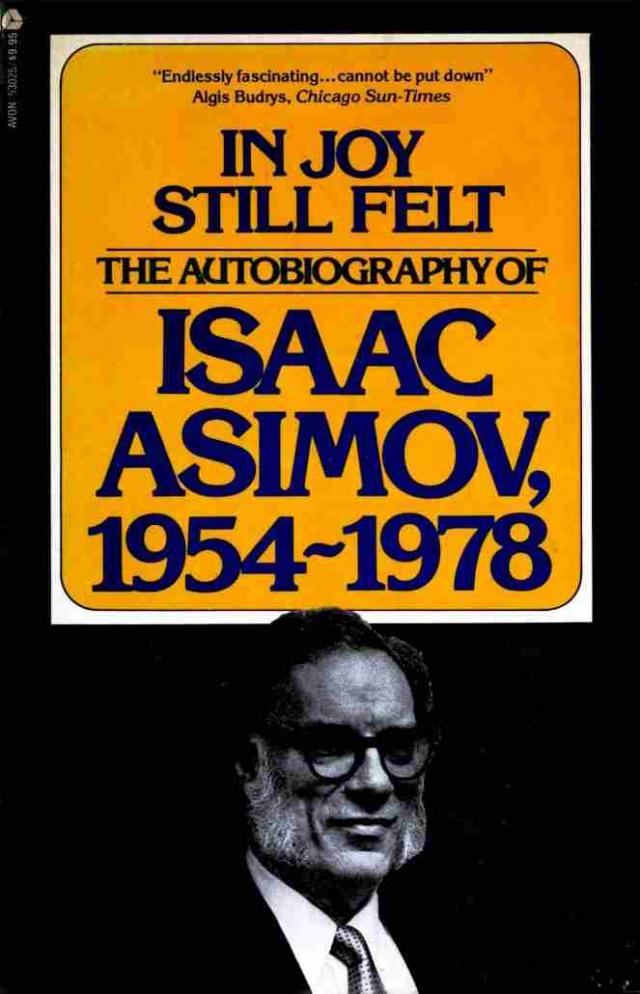
In Joy Still Felt: The Autobiography of Isaac Asimov, 1954-1978,
p.89


Bernie and Essie Fonoroff showed up unexpectedly. Bernie was wearing a beard and I would not have recognized him had Essie not been with him.
It was all delightful even down to the clothed life-sized plastic dummies scattered here and there to lend a sinister atmosphere,288 and we went home on the thirtieth completely happy.
19
For a couple of years now, I had been hounding Doubleday to put out new printings of those of my science-fiction books that were no longer in hard-covers. (They were all in print in soft-covers, to be sure.)
Once Cathleen became my editor, I put it up to her and she said she would look into the matter. I left it at that, for I knew that Cathleen would do what she said she would do.
And she did. On February 3, Cathleen and I had lunch together and she told me that Doubleday planned to put my out-of-print books into uniform triple-volume editions. Two would be put out to begin with. One would contain Earth Is Room Enough, The End of Eternity, and Pebble in the Sky, and the other would contain The Martian Way and Other Stories, The Currents of Space, and The Stars, Like Dust—.
It was on this occasion that Cathleen and I talked about the possibility of an autobiography, as described in the introduction to In Memory Yet Green.
20
Ever since I had been working with Harry Walker, the schedule of my talks had been growing heavier. They had even invaded the winter season, which until then I had managed to keep fairly free of travel.
I enjoyed the talks and sometimes the fringe activities as when, on February 10, I was taken to a farm while engaging in talks at IBM in East Fishkill and shown newborn lambs, allowed to pet a buffalo on the horn and, that night, even encouraged to look through a telescope in the snow so that I could see Saturn in all its beauty for the first time in my life.
But the traveling was tiresome and I found myself dragging. Janet began to get anxious, but I would not listen to any suggestion that I cut down on my engagements. It irritated me to be reminded that I might be subject to human limitations—especially as I grew older.
21
I was very fond of the TV situation comedy “Laverne and Shirley,” and on February 15 there was a touching episode involving Shirley and her ne’er-do-well father. At least it touched me deeply, and when it was over I thought I would call Robyn, who was now in her junior year at Boston College.
She answered the phone and with a fine affectation of carelessness, I said, “Have you seen ‘Laverne and Shirley,’ Robyn?”
She said, “One moment, Dad.” Then she called off to her roommates, “Guys! My father wants to know if I watched ‘Laverne and Shirley.’ ”
There followed wild laughter, and Robyn came back to the phone and said, “Yes I did, Dad.”
I said, “Why all the laughter?”
“Well, Dad,” said Robyn, “we were all watching and as they got drippier and drippier about fathers and daughters, and knowing that you always watch the show, I said, ‘Oh God, my father is going to call me as soon as this is over.’ And you did.”
I suppose it is humorous to have a father who’s so predictable.
22
Martin Harry Greenberg and Joseph Olander were editing a series of books on various science-fiction writers, each consisting of a dozen or so critical essays on their works. One of the first to be published was to be Asimov.
I received the manuscript of the collection on February 17, and read it with mounting astonishment. Some of the essays were fiendishly clever in interpreting my symbolism and intentions, but it was all news to me. However, I remembered Gotthard Gunther’s remark to me concerning “Nightfall” a quarter-century before, and I was prepared to assume that the critics understood my fiction better than I did and that I had put in more than I knew.
I acceded to the publisher’s request that I add an Epilog, and wrote “Asimov on Asimov,” in which I pointed out why I couldn’t possibly have inserted all the subtleties into my fiction that I was accused of having done. And then I refuted my own arguments and pointed out that I might have done so anyway.
Let the readers judge for themselves, I decided.
23
Robyn made up for the disappointment of the year before by arriving on February 19, 1977, to celebrate her twenty-second birthday with us. She remained with us till February 25, and on that day there was time for a concluding celebration, since Walker finally decided to do a collection of my juvenile detective stories involving my junior-high-school detective of “The Thirteenth Day of Christmas.”
I only had four stories involving him and they needed five, so I had written one “The Key Word” especially for the book. Eventually, Walker decided to call it The Key Word and Other Stories.
On February 23, also, I finished Mars, the Red Planet.
24
On March 2, I put together my thirteenth collection of F & SF essays, which I called Quasar, Quasar, Burning Bright, after the title of one of the included essays.
25
George Scithers had suggested that I write a Black Widowers story for IASFM. It wasn’t a bad idea. After all, I had written three that had appeared in F & SF, so why not one in my own magazine?
I needed something that would be suitable for a science-fiction magazine and, having just finished a book on Mars, I thought of a gimmick that would involve the appearance of the Martian sky. On March 8, then, I wrote my twenty-ninth Black Widowers story, “The Missing Item,” which George liked and accepted.
26
About a month before, Cathleen and I had discussed the possibility of my writing my autobiography. On March 9, more on impulse than anything else, I began it, to see how it would go—and it went like an iceboat in a strong wind. In my father’s year in Miami Beach, he had sent me a number of letters (at my request) concerning his early life, and these came in very handy indeed.
After racing through no less than fifty pages of manuscript, however, I found that I was still only three years old and just arriving in the United States. The notion dawned on me that it was going to be a long autobiography, and I began to worry about Doubleday’s reaction.
27
On March 16, the second issue of IASFM, Summer 1977, was published. Again a photograph of myself was on the cover—a profile shot this time, in a sport shirt and bolo tie.
The issue contained two tiny stories of mine, each five hundred words long or less. One, “About Nothing,” had appeared nearly two years earlier on a postcard published in Great Britain. A young man named George Hay had conceived the idea of “story postcards” in form analogous to the more common “picture postcards.” I don’t know how well he succeeded.
The second one, “Sure Thing,” was written especially for the magazine.
Both were gag stories, ending in outrageous puns that I thought terribly clever. I must admit, however, that these things are matters of taste.
28
On the same day that the issue appeared, a writer named James Lincoln Collier interviewed me. I had thought that Brad Darrach’s interview for People would represent a pinnacle for me, but Collier was interviewing me on behalf of Readers’ Digest, which, in terms of circulation, had to be a notch higher.
29
I had been giving numerous talks to IBM groups, both in the Poughkeepsie and Philadelphia areas, all through the fall and winter, and had been doing well enough for IBM to want to pin me down to something more elaborate. I was therefore asked to come to Miami Beach.
My impulse was to refuse at once, but the World Science Fiction convention for 1977 was to be held in Miami Beach the following Labor Day weekend, and I was actually anxious to go there if I could. It looked as though “The Bicentennial Man” might be nominated for the Hugo. If it were nominated and if it won, it would be my first award in the shorter fiction categories, and it would be nice to be there where it happened. Perhaps the trip for the IBM talk might test the practicality of going to Florida over the Labor Day weekend.
Then, too, it would offer us a chance to see the Everglades.
So I said yes, and at 10 a.m. on March 26, 1977, Janet and I boarded the train for the longest trip I had taken since my Army days thirty-one years before. We had a double room, which in some ways was more luxurious than a hotel room, since we had two bathrooms.
One discomfort was that we had to make our way to the dining car and back on four separate occasions. It meant scrabbling through six coaches filled with uncomfortable people, sprawling this way and that in an attempt to find some way of relaxing—crowded, smoky, smelly. I was altogether too conscious of our own luxurious accommodation and wondered if there might not be an uprising and if I might not be strung up on the nearest lamppost as a damned aristocrat.
We were at the Eden Roc Hotel in Miami Beach by 4 p.m. on March 27.
I gave my first talk on March 28. It wasn’t a solo. Alvin Toffler was on the stage with me, and George Herman of CBS News introduced us. The whole program was done with IBM éclat, and was therefore elaborately introduced by a young magician who, in my eyes, stole the show.
That night I gave another talk to a group of journalists and, in between, I was interviewed by three different people. My time was, in fact, rather tightly occupied, and Janet and I grew rather upset at this. There we were in Miami Beach and yet we had scarcely a moment in which to relax.
Ben and Barbara Bova showed up on the evening of the twenty-eighth, for Ben was also represented by Harry Walker and Ben, too, at my recommendation, was sent down to Miami Beach. The IBM people weren’t sorry, for he gave a terrific talk on the morning of the twenty-ninth. I was in the audience and loved it.
After the talk, I went out to Florida International University, where I met Joe Olander for the first time and gave a talk. In the evening I signed books at a Miami bookstore.
March 30 was our only day off, and that had been reserved for the Everglades. We were picked up by Daniel and Bettina Jackson, who were Olander’s friends, and they spared nothing to show us a good time. They even brought along a “picnic lunch” which, for elaborateness and excellence, reminded me of the lunches Carborundum had supplied for us on our trip to and from Niagara Falls five months before.
The director of Everglades National Park came along with us, and for hours we toured it, filling ourselves with alligators, ravens, pelicans, mahogany trees, strangler figs, and so on. Janet, quite predictably, fell in love with the alligators and wanted to feed them, but the director told her that would spoil them and do them harm. However, when one alligator nosed up to shore when we were having lunch, he turned out to have one leg missing (bitten off in a fight, presumably), and Janet, in an agony of sympathy, insisted on feeding him some of her lunch.
Rather depressing was the carnage done by the cold snaps just ten weeks before. There had been snow in Miami in January for the first time in living memory, and temperatures had gotten down as low as 19° F in the Everglades. The tropical vegetation had no defense against freezing temperatures and there were huge patches of brown death.
We reached the southern tip of Florida and I got out of the car so that I might stare at the Gulf of Mexico—which I had never thought I would ever see.
On the thirty-first, I gave a second talk with Toffler and Herman, one that was, actually, a repeat of the first—but for a new batch of IBM people. Then, immediately after the talk, we were raced to the station and put on the train. We were home on the evening of April 1.
The trip back was more tedious than the trip there and I ended being a little dubious as to whether I could face the Miami run a second time come Labor Day.
30
There followed hard upon that the low point of my winter’s heavy lecture schedule.
On April 6, I had to drive to Greenville, Pennsylvania, in the northwestern corner of the state, to talk at Thiel College. We drove much of the way through snow flurries, which did not accumulate and were no real danger, but represented a psychological hazard.
What was worse was that I came back from Florida with the beginnings of a cold that was degenerating into laryngitis, and the next day, April 7, I had to give two talks in Ohio, one at Youngstown State College and one at Cleveland State College, with informal talks, gracious luncheon and dinner chit-chat, and interviews interspersed. April 7 was virtually one solid session of talk on my part, with my voice slowly disappearing into a whispered trace and Janet almost beside herself with worry.
It was some satisfaction to me that in the three talks on the sixth and the seventh, I received three standing ovations, even though the final talk had to be carried out by whispering into a microphone.
Rather remorsefully, I tried to make things up to a very worried Janet by driving through Ashland, Pennsylvania, on the way home. It happened to be the little mining town in which Janet had been born a half century before. She had left it with her parents at the age of two, but she swore she remembered the main street.
31
We got home on the morning of April 9 and I promptly went to the Lunacon, New York’s local annual science-fiction convention, where, at Janet’s insistence, I wore a sign saying I had laryngitis so that people would not expect me to speak much.
Nevertheless, I did give a speech in a semiwhisper, talking about my autobiography and how I had discovered a published story of mine, “The Weapon,” that I had thought no longer existed. It was in this way that I managed to get a copy of the magazine in which it appeared from Forrie Ackerman within a week.
At home I found a letter from Lloyd Roth—who had reached retirement age. I was, and am, rather grimly thankful that my own profession is such that nothing but death can retire me.
32
On April 14, I received a call from Time. They needed an essay on what life in the United States would be like if the energy supply failed, and (they said) the editorial staff had decided I was just the man to do it. ,
I said (rather cynically, perhaps), “If you decided I was your man, then what you need is not content, but speed. Right?”
A little embarrassed, the gentleman on the telephone said, “We need it tomorrow morning.”
They had it the next morning, and three days later it appeared in the April 25, 1977, issue.
33
I just managed to get it done in time, for Janet and I were heading out to Mohonk Mountain House on April 15. Stanley and Ruth, at our recommendation, were coming, too, and the four of us spent an excellent weekend together. Of course, I gave a talk while there.
34
Fred and Babbie Whipple, whom I had first met in Boston twenty-eight years before, visited us unexpectedly and briefly on April 24. Fred, now seventy, was as slim and courtly as ever.
35
April 27 was the official publication date of The Collapsing Universe. Advance sales were very gratifying; Pocket Books had bought the paperback rights at a generous advance, and the Walkers, very pleased, hosted a publication party at the Hayden Planetarium, the most lavish shindig of the type in seven years.
36
Even better was the Mystery Writers’ of America award banquet on April 29, which Janet and I attended together for the first time since we had met at one eighteen years before.
Best of all was the Nebula awards banquet on April 50. I was toastmaster and I think I did a better job at it than I had ever done in my life. Cliff Simak was there and it was the first chance I had to meet my old friend since the Boston convention six years before.
Simak was given the Grand Masters award, and was the third to win it. The first had been Heinlein, of course, and the second had been Jack Williamson. All three were eminently deserving.
As for the Nebulas themselves, all else paled when I found I had been voted the Nebula for “The Bicentennial Man” as the best novelette of the year. I had hoped for it, but had not really dared expect it.
In the midst of my jubilation, I took a good look at the Nebula and found that my name on it had been spelled “Issac Asmimov”—both names wrong. Naturally, the SFWA offered to supply me with a new one, correctly spelled, but I refused. I said, rather dryly, that the misspelling made it more valuable and a better conversation piece.
37
Then came another long trip, one that was to take me down to Newport News, Virginia. We drove southward on May 1 and I kept assuring Janet that I would cut down on the long trips, but some were scheduled in the future, one even as late as April 1978, and those had to be fulfilled.
On the way back, on May 3, Janet and I stopped at Williamsburg, which we had last seen that famous snowy day seven years before, and we were home on May 4.
38
May 8 was Mother’s Day, and for the first time, both Janet and I were motherless.289 That Mother’s Day I therefore spent in secular fashion at the New School for Social Research, where I took part in a panel on “Judaism and the Future.” I had protested I knew nothing about Judaism, but the sponsors of the panel insisted and my talk was the only one that didn’t mention Judaism.
I managed to get into a dispute with Elie Wiesel, who irritated me by saying he didn’t trust scientists and engineers since so many of them had been involved in the Holocaust.


