

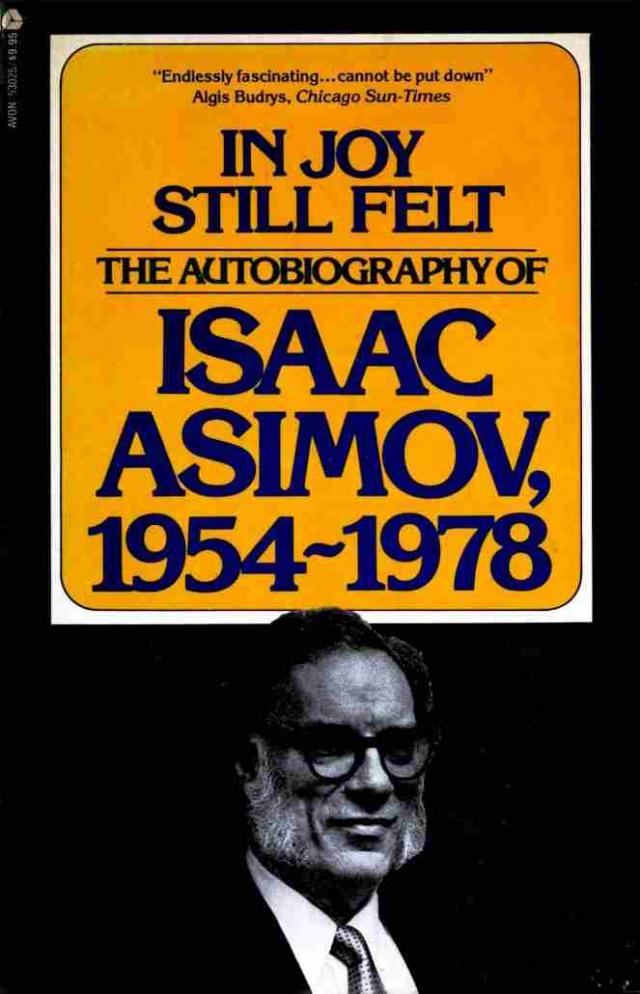
In joy still felt the au.., p.17
In Joy Still Felt: The Autobiography of Isaac Asimov, 1954-1978,
p.17


The fact, therefore, that I had never taken any courses in astronomy merely meant that I was weak on some of the mathematical aspects of celestial mechanics and on the nuts and bolts of telescopes and other instrumentation.
On the descriptive and conceptual aspects of astronomy and even on some of the celestial mechanics, I had an iron-bound grip, so that I began work on The Clock We Live On with absolute assurance.73
And, as I went on to discover, each time I wrote a book on some subject outside my immediate field it gave me courage and incentive to do another one that was perhaps even farther outside the narrow range of my training. Beginning with July 1, 1958, then, I advanced from chemical writer to science writer, and, eventually, I took all of learning for my subject (or at least all that I could cram into my head—which, alas, had a sharply limited capacity despite all I could do).
As I did so, of course, I found I had to educate myself. I had to read books on physics to reverse my unhappy experiences in school on the subject and to learn at home what I had failed to learn in the classroom—at least up to the point where my limited knowledge of mathematics prevented me from going farther.
When the time came, I also read biology, medicine, and geology. I collected commentaries on the Bible and on Shakespeare. I read history books. Everything led to something else. I became a generalist by encouraging myself to be generally interested in all matters.
Fortunately, I didn’t have to approach anything (or almost anything) completely fresh. My avid and generalized reading as a youngster came to my aid, for as the years passed, I discovered (with a great deal of pleasure) that I simply never forgot the trivia I had read. It was all there in my head and required only the slightest jog to spring to the surface.
This is not to say I wasn’t capable of making mistakes through carelessness or through writing overhurriedly or through being misled by my sources—but none of those mistakes (as far as I know) ever betrayed ignorance of the subject. I grew more casually confident of my polymath abilities with each year, and it was that, even more than my prolificity, that has impressed people and led to my gaining a rather unusual reputation for “knowing everything.”
As I look back on it, it seems quite possible that none of this would have happened if I had stayed at school and had continued to think of myself as, primarily, a biochemist.
For that reason, it has been hard for me to think of myself as having been ill used in 1957 and 1958. Rather, I was forced along the path I ought to have taken of my own accord if I had had the necessary insight into my own character and abilities.
While I cannot believe that Lemon and Keefer had my welfare in mind, it all worked out for my benefit whatever they had in mind, and I feel no resentment against them.
11
In the summer of 1958, we decided to try a new experiment in summer vacations. We rented a cottage on the beach in Marshfield, Massachusetts, for three weeks. On July 12, 1958, we drove there and settled in.
It was a quiet vacation. To show you how unexciting a time it was, my chief memory of the period is that Robyn went to sleep while chewing gum.74 During her sleep, the chewing gum transferred itself into her hair and we spent what seemed like several weeks trying to tease it out, bit by bit. In the end, we had to simply cut a hank of hair off with the scissors to everyone’s grief, for she had, and has, beautiful blond tresses.
I did make occasional trips back to Newton to pick up my mail. In this way, I got a copy of the September 1958 Galaxy, which contained “The Ugly Little Boy.”75 Horace had, for some reason, decided that that title wouldn’t sell magazines. Maybe he thought people would find it unpleasant. So he changed the title to the terrible one of “Last-born.” I changed it back for every other appearance of the story.
I also got the galleys to The World of Nitrogen, which gave me something to do.
The Bounds of Infinity, however, which I had hoped to advance mightily in the course of the vacation, simply didn’t catch on. I moved more and more slowly and with greater and greater effort. It did occur to me that perhaps the loss of my job was destroying my ability to work. Therefore when Leo Margulies asked me for a story for Satellite, I thought up a short piece that I called “Benefactor of Humanity” and dashed it off at a feverish pace, more to convince myself I could do it than for any other reason. Margulies took it without much trouble.76
On August 2, thank goodness, we were home.
12
On August 4, I received official notification that my job as associate professor of biochemistry was renewed for another year. I took great satisfaction in that, and from then on, for a decade or more, I made a point of showing up at school periodically to pick up my mail. I would not allow it to be forwarded to my home, for it was important to me to show my face at the school and make it quite plain I belonged there as much as ever.
13
On August 12, when I visited Bob Mills in New York, he asked me if I would continue my Venture science column, but for F & SF.
I agreed very happily and instantly passed over a short science column on meteoric dust on Earth and on the Moon, which I called “Dust of Ages” and which I had intended as the fifth column in Venture.
It appeared in the November 1958 issue of F & SF, and finally I had the column I wanted.
The first column in F & SF was only twelve hundred words long, and the notion was that each was going to be of that length. Bob, however, experimented with a four-thousand-word length for the second and third column, went back to a twelve-hundred-word length for the fourth, but then with the fifth, it was four thousand words again and has remained that ever since. I was to get one hundred dollars per column, and they were to continue indefinitely.
At the very beginning, Bob made some suggestions, but that stopped very quickly, and it came to be understood that I was to write what I wanted, exactly how I wanted, and that I was to get galleys of each column so that I could see to it that it was set in print just as I wanted it to be.
It was an ideal arrangement. Bob Mills was the first to call me “The Good Doctor” in blurbing my articles. Eventually, the articles settled down in the form in which they now exist, with each one being introduced by some personal anecdote or reminiscence (usually funny, always true).
It was in these articles, in fact, that I first developed my leisurely and personal style of talking to the readers directly.
14
My parents were now spending part of the summers in the Catskills, at the Paramount Hotel. The first time they went there, my father was so inexperienced that he had only city clothes with him. By the next time, though, my parents were old-timers who went rowing and indulged in other activities as well.
My father, in particular (I gathered from what I was told) made the surroundings hideous by talking about nothing but me. He always had books of mine with him and he would eagerly show them to people but would not allow them to touch the book. No fingerprints but his own must be upon them. How he managed to survive an onslaught from an infuriated mob, I don’t know.
He used to call me up in those days to ask me how I was doing. I had de-emphasized my misadventures at school, but let him know, carefully and truthfully, that my earnings were steadily rising. He was doubtful about this. It seemed that one of his habits on passing a bookstore was to walk in and demand to see any books they had by Isaac Asimov. They generally didn’t have any.
“How can you make a living, Isaac? Are you sure you’re telling me the truth?” he would ask.
“Pappa,” I would say, “most of my sales are library sales, and I get money through book clubs and paperbacks. I assure you I am making plenty of money.”
“Why don’t you tell Doubleday to advertise you more?”
“That’s their business, Pappa. I don’t interfere.”
As a matter of fact, I have constantly been asked by relatives, friends, even strangers, why my publishers don’t advertise me more. I pay no attention to that; I have never urged promotion on my publishers; I get uneasy on those few occasions when they do invest in publicity. My feeling is that my books support each other and my talks support them all and that that is the best promotion.
Of course, none of my books has ever been a best seller in the sense that none has sold a great many copies in any one year. On the other hand, many of them sell a respectable number year after year indefinitely—and that is better. Furthermore, if you consider all my books to be a single book entitled Isaac Asimov each with a different subtitle, then I have a best seller every year.
15
Robyn celebrated David’s seventh birthday on August 20, 1958, by running a fever. David joined her a few days later, and to my horror, on August 25, I had a fever of 101.8°.
In the course of my adult life I have had the usual incidence of colds and intestinal upsets, but I am almost never feverish. This was the first fever I had had in twenty-one years, and I took it as a personal insult.
Actually, it was the start of another bout of bronchitis, such as the one I had had the previous fall. This was a worse one, for I continued to cough for three months.
It occurred to me this time that the fault lay in the air conditioning of my workroom during the summer. I kept the air conditioner on maximum and I worked in my underwear (my general costume at the typewriter). I also kept the door closed and walked freely in and out of the room from cold to heat and back to cold.
I took thereafter to wearing a shirt and pants when the air conditioner was on, and to keeping the door to my attic room open to lower the temperature difference in and out. Thereafter, I had bad attacks of bronchitis no more.
16
On August 22, we bought a parakeet. It was the first pet the children had ever had, and the first I had ever had that wasn’t a cat. David was fascinated by the little bird and somehow trained it to perch on his shoulder. It wouldn’t perch on anyone else’s.
It was rather a shame he couldn’t get along with other children as he could with the parakeet. We decided it was wise to follow the recommendation of the school and let him repeat the first grade in order to give him another year to adjust himself to classmates before progressing.
17
At this time, the quiz shows were in their heyday on television. There was “The $64,000 Question” and all its imitations. In such shows people answered questions of the type that required short answers based on memory alone. No judgment was required. (“On what day was Abraham Lincoln assassinated?” “On April 15, 1865.” “You are right. Give that man $100,000.”)
I didn’t like the shows and rarely watched. I saw no value in that sort of question-and-answer setup and, in fact, I felt it cheapened the whole matter of intelligence down to the parlor-trick level.
On August 26, 1958, the matter came around to me. A new quiz show, “Brain and Brawn,” was beginning, and I was asked to be on, along with Willy Ley.
I was tempted, but a little thought changed my mind. Why lend myself to such nonsense? If I answered questions correctly, what did I prove but what everyone knew to begin with—that I had a trick memory and instant recall. On the other hand, one simple question, answered incorrectly, would be incredibly humiliating.
I thought of spelling “weigh” W-I-E-G-H. I thought of Sprague de Camp who had managed to get on “The $64,000 Question,” and who (for reasons known only to himself and God) chose motion pictures as his category, then muffed the very first question.
So I refused, using my bronchitis as a handy excuse.
Later on, when the newspapers erupted with scandals concerning these shows—to the effect that they were rigged, that contestants were coached in their answers—I was delighted I had resisted. I honestly believe that I would never have consented to let myself be coached and would never have knowingly been involved in any fraud—but would I have been believed?
18
The November 1958 Astounding had my article “Our Lonely Planet,”77 and I began a new book for Abelard-Schuman, The Kingdom of the Sun, which dealt with the solar system.
My novel, on the other hand, continued to languish. There was no way in which I could force myself to work on it. All I wanted to do was nonfiction. On October 20, 1958, I abandoned The Bounds of Infinity and never returned to it.
Yet that didn’t mean I abandoned science fiction entirely. I had lunch with Bob Mills in New York on October 23, and he asked me to write a story for him. He said that that morning he had seen the name Lefkowitz two or three times, each time spelled differently, and he thought there was a story there.
“What kind of a story?” I asked blankly.
“I don’t know,” he said, pettishly. “A story! You’re the writer.”
So on the twenty-ninth, I began a story about a man who is haunted by Lefkowitzes in different spellings and called it “Unto the Fourth Generation.” I had it done in a day, sent it off, and it was accepted. A very nice little story, I thought. (Bob Mills was now editor of F & SF, by the way, Tony Boucher having left the post.)
“Unto the Fourth Generation” is the only even faintly Jewish story I have ever written, in the sense of its dealing with what might be considered a Jewish theme.
As soon as “Unto the Fourth Generation” was concluded, I wrote a slight piece called “Rain, Rain, Go Away.” Mills had suggested that one, too, but he rejected it when he saw it.
19
Robyn was going to a nursery school three days a week, and on October 31 she joined David for the first time in Halloween trick-or-treating. David wore a leopard costume and Robyn went as Little Red Riding Hood.
Robyn was already showing signs of the absolute fearlessness that was to characterize her in her relations with “bullies.” She was as fierce as David was gentle. When other children would pick on David, three-year-old Robyn would charge forward with a “You let David alone” and would loose an ineffectual shower of blows on the other child.
I feared for both in later life—for David, who was sure to be scapegoated, and for Robyn, who was sure to join every fight on the weaker side.
20
My Straight-Democratic vote on November 6, 1958, was more or less the mood of the nation, and I stayed up till 2 a.m. to enjoy the spectacle of another Democratic Congress despite furious campaigning on the part of Vice President Nixon. My comment in my diary was, “A terrible licking for Nixon, in particular, that dirty bastard.”
21
The death of Cyril Kornbluth, nine months before had had a peculiar effect on me. I didn’t say so in the diary, but it seems to me that I remember his death having made the first page of the New York Times in a box in the lower left-hand corner—though perhaps it was only on the obituary page.
A queer kind of envy overcame me, a feeling that I might not get equal billing when it came my time to die, and a frustration at never knowing whether I had or not.
I recognized the feeling to be a silly one and I decided to exorcise it by writing a story about it. After a false start, I tried a second time on November 4 and carried it through.
I called the story “Obituary,” and actually it was more a thriller than a science-fiction story, but it was a thriller in which the villain used time travel to see his own obituary. I think it is the only story I ever wrote that was in the first person with a woman as the narrator, and I think the story was a good one. I think it’s one story of mine that has unjustly been passed over in anthologies. Bob Mills did buy it, however.
22
On November 14, I got a letter from Norman Lobsenz, the new editor of Amazing. He asked for stories.
I pointed out that the March 1959 issue would be the twentieth anniversary of the issue that contained my first published story, “Marooned off Vesta.” Should I not write another story for that issue? He agreed at once and promised to reprint “Marooned off Vesta” in that same issue.
I decided to have the three characters of “Marooned off Vesta” come back for a twenty-year reunion, so I pulled out my copy of “Marooned off Vesta” and read it carefully, looking for something I could hang a peg on. I found some lines that read, “He did manage, however, to pick up a small field-glass and fountain pen. These he placed in his pocket. They were valueless under present conditions—”
I did nothing more with those objects in the story. They were only mentioned to give an air of verisimilitude to a nightmare journey across the remnants of a wrecked spaceship. I now picked them up, however, and built my story ‘“Anniversary” about them.
I began it on November 21, finished it the next day, and sent it off to Amazing, which accepted it at once. I also wrote another biographical sketch to bring that first, embarrassing one up to date.
23
The Massachusetts School of Art was inducting a new president. Protocol called for other college presidents to attend and greet their fellow. Under such circumstances, most sent proxies. President Kirk of Columbia, finding that a Boston professor (me) was a Columbia alumnus, asked me to be his proxy and, of course, I was flattered enough to agree.
What I didn’t know then, but found out shortly thereafter, was that I would have to take part in an academic procession wearing academic robes. I had avoided that nonsense throughout my own college career, but on November 20, 1958, thanks to my vanity, I found myself swathed in medieval gown and mortarboard—for the first time in my life—taking part in a ceremony that lasted forever.
24
John Campbell had a new project. He was going to form an “Interplanetary Exploration Society,” which was going to become a power in the land. Taking care of the details was an elderly gentleman who, John said, had organized the Diners Club, so that he knew all about organizing successful societies.


