

In joy still felt the au.., p.56
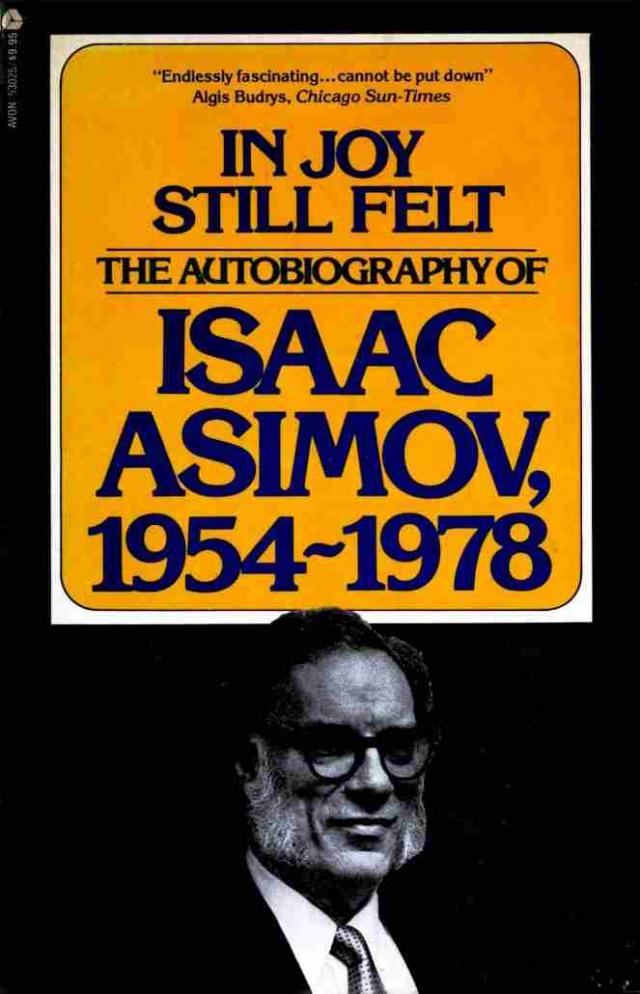
In Joy Still Felt: The Autobiography of Isaac Asimov, 1954-1978,
p.56


It was not just that he had become disillusioned in his liberalism; he had joined the enemy camp with enthusiasm. In fact, we all spent the whole evening that time at the Whipples’ arguing the matter of civil rights for blacks, and Al took up what seemed to me to be a distressingly anti-black stand. I argued with him vehemently on that occasion.
I became very sensitive thereafter to his strip “Li’l Abner,” which, it seemed to me, now had sequence after sequence that made fun of student viewpoints, of antiwar sentiment, and of the campaign for civil rights. None of this is against the law, of course, or even necessarily immoral, but Al Capp’s humor seemed to me to be rather vicious, and I writhed.
Finally, when it seemed to me that his current sequence was making unfair fun of a fictional minority group that could only be equated with the blacks, I dashed off a one-sentence letter to the Boston Globe, in which the strip appeared. It went, “Am I the only one who’s grown tired of Al Capp’s anti-black propaganda in his comic strip, ‘Li’l Abner’?”
On September 9, 1968, the Globe ran the letter. I was pleased, but didn’t give the matter much thought.
On September 10, at 3:00 p.m., the phone rang and Al Capp was on the line.
“Hello, Isaac, I saw your letter in the Globe. What makes you think I’m anti-black?”
“Hello, Al. What do you mean, what makes me think you’re antiblack? We argued all evening on the subject at the Whipples’.”
“Can you prove I’m anti-black in a court of law?”
“Perhaps not, but I wouldn’t try to.”
“You’re going to have to.”
I sobered up at once. Till then, I thought we had been bantering each other. I said, “Al, are you saying you’re going to sue me?”
“Of course I am. I can’t allow you to libel me in this manner.”
I said, “Well, wait. Are you going to suggest an alternative to a lawsuit?”
Al said, “Yes, you’ll have to call off the Black Panthers.”
“Come on, Al, I’m not the head of the Black Panther movement.”
“Well, you’ll have to write a letter of apology to the Boston Globe, saying that I’m not anti-black, that you regret having wrongfully accused me, and you’ll have to make sure that the Globe prints it.”
“All right, Al,” I said, thoroughly chastened and very scared. I had never been sued, and the mere thought of being involved in this kind of legal fracas turned my blood to cherry juice and my spine to jelly.
I went up to my office, put the paper in the typewriter, and began to write an obsequious letter of apology.
It wouldn’t come. The words simply wouldn’t type out. I wanted to apologize and get off the hook, but my typewriter would not cooperate. After a while, I realized that what it amounted to was that I would rather be sued and go through hell than apologize. I felt that I was in the right, and I was not going to back down.
So I called a lawyer friend.
He laughed. “Capp can’t sue you,” he said, “unless he sues the Boston Globe, too. They printed the letter.”
I said, “But I sent it to the letter column intending it to be printed.”
“That makes no difference. You didn’t force them to print it. They printed it of their own choice. If they choose to print a libelous letter, they are as guilty as the letter writer, so you just call the Globe, tell them Capp is threatening a suit, and let them worry about it.
“Besides, Isaac, you can say anything you want to about a public figure, unless it is something you know is untrue and you say it maliciously in order to do him harm—and that’s very difficult to prove. Al Capp is a public figure, and so are you, by the way, so both of you are fair game.”
I felt a little better, and called the Globe. I spoke to the editor of the letter column and he laughed and told me not to worry, repeating almost exactly what my lawyer friend had said. He said the paper’s lawyers would take care of it.
They did. At 3:00 p.m. on September 11, just twenty-four hours after Capp’s call, the letter-column editor called to tell me that Capp had cooled down. It had been pointed out to him that a sentence in the letter column was easily forgotten, but that if he chose to make a lawsuit out of it, it might become a cause célèbre and he would be made to seem, rightly or wrongly, the spearhead of anti-black sentiment in the United States. He saw the justice of that and dropped the whole thing.
It was over, but for twenty-four hours I had been a very frightened person. Taking a strong stand and refusing to back down may seem very fearless, but behind it there was sheer terror.
29
The Al Capp affair had an unexpected side effect. For twelve years Gertrude and I had had a running fight with the junior-high students who used our street to walk to and from school. We attempted to keep them from noisily congregating on the sidewalk outside our house.
It had been an endless and a losing fight. The attempt to drive them away insured their making a point of trying to hang about our place. Though we could go out and make them move on, it meant being at our windows twice a day, and churning up our adrenalin, and going out and arguing. For them it was merely a bit of excitement.
We could never work out what to do, and then on September 11, the Globe’s letter-column editor called just as the youngsters were going home from school and Gertrude was out there arguing with some of them. I came out of the house in the very best of spirits over my rescue from a deadly and expensive lawsuit, and called out to Gertrude, “Everything’s all right. Go inside and I’ll take care of this.”
And I did! Bursting with good humor and ebullience, I talked to the kids for the first time with affection. I joked with them, kidded around, sparred a little with one of them, put my arm around the shoulders of another, told them (in answer to a question) how many books I had published and why that meant I was eccentric and had to have quiet. In no time at all they were eating out of my hand.
I don’t know why, in twelve years, I had never tried it before. It wasn’t as though I hadn’t had hints . . .
For instance, once, when I went to mail letters at the mailbox, which happened to be right at the corner of the school, a group of youngsters were about the mailbox.
They looked threatening to me, distinctly gangsterish. As I approached, trying to seem calm, I was certain one would pull a switchblade on me, or that they would refuse to let me near the mailbox, or that they would destroy the mailbox after I had deposited my letters.
As I approached, wary and tense, one of them said, “Hello, Dr. Asimov. We’re reading I, Robot in class, and we like it a lot.”
At once I could see they were a group of little boys, soft-faced and gentle, intelligent and eager.
“That’s good, fellas,” I said. “Keep plugging and get good marks.” They opened the mailslot for me in very Boy Scoutish fashion and all was well.
There were other examples of this, too—so why did I insist on setting up a war between myself and them?
That was the good aspect of the Capp affair. Finally, I learned. We never had trouble with the youngsters again. They virtually tiptoed past the house, and I made it a practice to be outside once in a while, to wave to them and kid around a bit.
30
It was about this time, too, that I began once more to experiment with facial hair. Increasingly conscious that more and more men were altering their hair styles and that only quite old men were retaining the older look, I began to shave my cheeks lower down.
Little by little I extended my sideburns, and by the time of the Al Capp incident they were halfway down my cheeks.
They continued to extend and to grow bushier and, eventually, they reached the angle of my jaw, while the individual hairs grew to be two inches long or more. They became a permanent feature of my face, and it is now difficult to believe early photographs that show me without sideburns.
31
By September 25, 1968, I had completed the first draft of my annotations of all but five of Shakespeare’s plays, and I had about half a million words done. I had been working on it, on and off, for half a year, and I could resist no longer. I wrote an Introduction and began final copy of those plays I had done.
28
Approaching the Hundredth
1
On September 26, 1968, I had lunch with Austin, Mary K., and Walter at Locke-Ober’s. Austin said, “You must be approaching your hundredth book, Isaac.”
I said, with satisfaction, “Yes, indeed, the advance copy of The Dark Ages, which I received last week, is the ninety-second.”
“And how many are in press?”
“Seven,” I said.
“That brings it to ninety-nine,” said Austin. “What are you planning for your hundredth book?”
“Nothing special,” I said. “It hadn’t occurred to me that there should be anything special.”
“There’s got to be,” said Mary K., “and since we’re suggesting it, we’ve got to have it.”
I promised to think about it and even joked that it should be called Opus 100, but they took the joke seriously, and that became the name.
I decided quickly that the only appropriate format for the hundredth book would be to include passages from as many as possible of my first ninety-nine books, stressing the variety of subjects I had covered, and to include autobiographical comments.
Austin agreed heartily.
2
Rusty de Camp, Sprague’s son, with whom, twenty-three years before, we had had a harrowing baby-sitting experience, was now a staid engineer, as severely straight as Sprague himself, and very like Sprague in appearance, except for his reddish hair.
Rusty was living in a Boston suburb now, and since Sprague and Catherine were visiting him, I joined them on September 28. Rusty had married a divorcée with several young children, so that Sprague and Catherine (now sixty, but both as good-looking and ageless as ever) were instant grandparents.
3
Asimov’s Guide to the Bible was four hundred thousand words long, and I was quite aware that Doubleday planned to publish it in two volumes. The natural way of dividing it was to put the Old Testament in one volume and the Apocrypha plus the New Testament in another.168
For some reason, Doubleday decided not to publish both books at the same time, but to do so in successive falls—perhaps to take advantage of two different Christmas seasons. On October 5, I finally got the first volume, Asimov’s Guide to the Bible: The Old Testament, more than three years after I had started writing it.
Naturally, I sent a copy to my father in Miami Beach, quite relieved that the book did not include the New Testament. That didn’t help much, though. My father phoned me to tell me that he had gotten to page 7 and then had closed the book and would read no more. Although he didn’t go so far as to actually excommunicate me, I decided right then that when the second volume arrived I would not send it to him.
4
There was no difficulty in doing Opus 100. The autobiographical portions were sheer pleasure, and by October 17 I had a sizable sample to present to Houghton Mifflin for their consideration.
I knew there would be the mechanical difficulty of obtaining the books from which excerpts were to be included (or typing them up, if necessary) and of getting all the permissions, but that would be just a matter of time and tedium, and Houghton Mifflin promised to do the necessary scutwork.
5
I had become sufficiently conscious of the longevity of my career to make a note in my diary on October 21, 1968: “This is the thirtieth anniversary of my first professional sale—‘Marooned off Vesta.’ ”
The next day I set off on a drive by myself to Columbus, Ohio, where I was slated to give a talk and receive a plaque. The payment for the talk, a mere $250, was by no means sufficient to justify so long a drive, but I wanted the plaque. It was from the American Society for Information Science.
I was in Columbus by noon of the twenty-third, and found that the society had arranged for me to have a penthouse suite at a fancy motel. It was a much more elaborate one than I required, but it was a welcome sign of their eagerness to treat me well.
When it was finally dinnertime I found myself at a gathering of just about a thousand people, who filled a huge dining room from end to end. It was rather daunting. I had never had so large an audience sitting at tables; they make a far more impressive crowd than the same number sitting tightly packed in an auditorium.
What’s more, the master of ceremonies, a large, fat man, had a number of items of business to dispose of and, quite unexpectedly, proved to be a very good and entertaining speaker.
I was cast down at once, for a good preliminary speaker wears down the audience and uses up its laugh potential. I had been planning to give my Mendel speech, which was made to order for information people, and now I went over it in my mind to see how it could be spiced up and more effectively belted out.
The gentleman on my right, noticing perhaps that I was looking glum and abstracted, said, “We’re looking forward to hearing you, Dr. Asimov.”
I said, my glumness not assuaged, “I may not be any good.”
“I know you will be, since I’ve heard you before and you were terrific.”
“Oh? Where did you hear me?”
“At the Gordon Research Conferences a couple of years ago, where you addressed the Information Division. That’s what gave us the idea of inviting you now. You gave a speech about Mendel at the time.”
I stared at him with horror. “Are there many people here now who heard me then?”
“At least half, I should say.”
I had just ten minutes to prepare another speech in my head. That wasn’t what bothered me; ten minutes was ample time.
But think! If the gentleman on my right had not made his spontaneous comment, I would not have known this important fact of audience overlap. I would have gotten up, given the same speech that a large number of them had heard, and it would have been a complete and embarrassing frost.
Instead, when it was time for me to talk, I told them exactly what had happened in such a way as to get them laughing, and then gave a completely different talk on the future of communications, which was a huge success.
Since then I have been very conscious of this danger of duplication and have not relied on finding out by accident. I have, whenever possible, asked the people in charge about the likelihood of audience duplication.
6
November 5, 1968, was election day, and I voted unhappily for Humphrey. I was afraid that Nixon would win, and he did—by a more narrow margin than I had expected. What’s more, Congress remained Democratic.
I was dreadfully depressed, convinced that a Nixon presidency could only mean misery for the United States, and glad that I was slated to give a talk to a group of librarians in Foxboro, Massachusetts, on November 6. It would help take my mind off Nixon.
To librarians, I invariably give personal talks—about me and my books—and they just as invariably love it. In the question-and-answer period that followed, one librarian rose to make a statement that I have never forgotten:
“Dr. Asimov,” she said, “I just want you to know that in our branch, your books are the most frequently stolen.”
There was widespread laughter and I said that this seemed to indicate that either my readers were particularly dishonest, which I doubted, or that once having one of my books in their possession they couldn’t bear to give it up on any account—something for which I couldn’t blame them.
7
On November 9, I finished Opus 100, and on November 10, I put together my seventh F & SF essay collection, The Solar System and Back.
On November 21, the day I took The Solar System and Back to Doubleday, the secretaries presented me with a sweatshirt on which lettering had been placed that read “Isaac Asimov Is a Genius.” The intent was to embarrass me, of course, and they succeeded. I was never able to wear that sweatshirt, although the time was to come when Robyn would wear it with complete lack of concern.
8
At a meeting of the American Academy of Science on November 13, I was part of a conversational group that was joined by Nobel Laureate I. I. Rabi, whom I had never met before. He at once began talking, and I listened with becoming reverence.
When Rabi was done speaking, I began to say something, and Rabi, wanting belatedly to add a remark to his own comments, began to talk again, ignoring me. I fell silent, out of respect. When he was through, I began again, and darned if he didn’t interrupt me a second time. I fell silent again, but now I was seething. He had consumed my store of respect.
When he was through, I made a third attempt at saying something, and when, for a third time, he interrupted me, I simply raised my voice and ran over him. Rabi stared at me as though he now saw me for the first time, raised his arm, and struck me.
I staggered a bit and finished my comments. I was terribly tempted to hit him back, but he was older than I was and smaller, so I couldn’t.
9
Life was becoming a mosaic of old and new friends. On November 22, I had lunch with Walter Sullivan, the science writer for the New York Times, and met him for the first time. He was tall, slim, with a reddish complexion, a shock of white hair, and an air of complete gentlemanliness. He proved a perfectly marvelous person.
In the evening, I talked at the Hunter College Playhouse as a favor to my old friend and mentor, Dr. Dawson, and had dinner with him beforehand. At the playhouse, I met Morris Joselow, who, twenty years before, had helped me back to the lab after I had celebrated my Ph.D. by getting drunk.


