

In joy still felt the au.., p.27
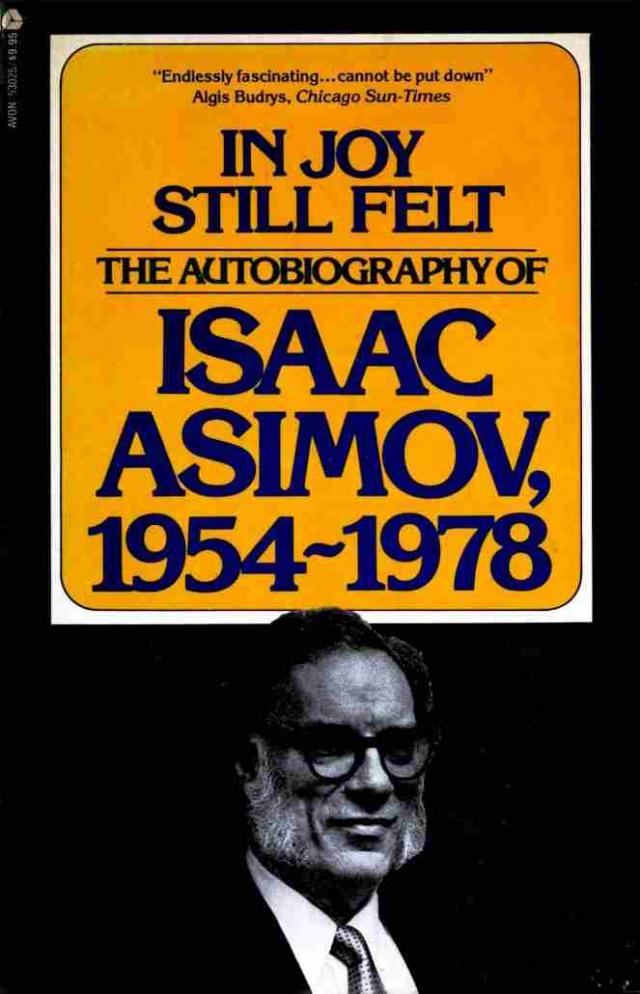
In Joy Still Felt: The Autobiography of Isaac Asimov, 1954-1978,
p.27


“Is someone there with you?” said Mary, in what I took to be a suspicious manner.
“Yes,” I said, “but it’s a man with a beard. We’ll be on television together next week.”
“Yes?” said Mary, the suspicion more clearly marked. “You’re sure it’s not a girl?”
“For goodness’ sake, Mary, if it were a girl do you think she would be talking while I was on the phone with my mother-in-law? Hey, John, come here and say hello.”
Dutifully, John came over and said, “Hello,” and I suddenly realized that he had (so help me) a soprano voice. No wonder Mary thought there was a girl in the house with me.
I snatched the phone away. “It’s a man,” I said, by now in a near frenzy, “but he has a high voice. His name is John McCarthy and I’ll introduce him to Gertrude when she comes home.”
I wasn’t desperate enough to keep John overnight and make him wait for Gertrude, but she did get to meet him eventually and to note the timbre of his voice.
11
The year 1960 ended with my earnings within twenty-five dollars of the thirty-two-thousand-dollar mark, my third consecutive year in the thirty-thousand-dollar area. If I were to regard my writing alone, I had every reason to be happy, for I had topped 1958 and 1959 by a narrow margin and had set a record.
Nevertheless, 1960 fell below my total 1958 income (counting the last bit of my school earnings) by over two thousand dollars. If I could best that mark, I felt that I would be entirely satisfied.
There was hope that I might do exactly that in the next year, for in 1960 I had published no less than eight books, well beyond the previous record of five in 1957, and surely each should contribute to my earnings the next year. They were:
33. The Living River (Abelard-Schuman)
34. The Kingdom of the Sun (Abelard-Schuman)
35. Realm of Measure (Houghton Mifflin)
36. Breakthroughs in Outer Space (Houghton Mifflin)
37. Satellites in Outer Space (Random House)
38. The Wellsprings of Life (Abelard-Schuman)
39. The Intelligent Man’s Guide to Science (Basic Books)
40. The Double Planet (Abelard-Schuman)
Four of the eight books were published by Abelard-Schuman, but I had no further books in press with them. The delays in publishing and the unsettling turnover in editors had driven me away.
It was, in a way, a shame. Hal Cantor had, by now, also left, and Frances Schwartz, Lew’s wife, was in charge of the Juvenile Department. She was a pleasant, no-nonsense woman, whom I liked a lot. It was clear she was there to stay, but I now had commitments elsewhere, and the Abelard-Schuman phase of my career was over after having lasted eight years. (And I had two new publishers as replacements among the 1960 books—Random House and Basic Books.)
It was also true that 1960 was the first year, in the eleven in which I had so far been publishing books, in which I didn’t have a single Doubleday book published. That was a bad feeling, but I had Life and Energy in the works for them, and it was well along.
12
I turned forty-one on January 2, 1961, but there was no hassle about it. As I said in my diary that evening, “Forty-one isn’t as old as forty.” No age really is. After a while, each year is a victory, and you begin to be first relieved, then victorious, and finally (I imagine) triumphant.
13
On January 6, 1961, while on a visit to New York, I had, for old times’ sake, dropped in at Henry Holt’s to see Walter Bradbury. It was just a social visit. I had not come to propose a book; neither did he suggest one. I thought he looked drawn and tired.
I wasn’t wrong, for on the thirteenth, I received a letter from him to the effect that immediately after I had visited him, he had resigned his position. Not because I had visited, you understand; that was just a coincidence. Despite the fact that Henry Holt had made him an offer he “couldn’t refuse,” he had not been happy there. He went on to take a job at Harper’s.
14
On January 16, 1961, I received a copy of Words from the Myths, which I had written during the weeks of my despair over The Intelligent Man’s Guide to Science. It was my fifth Houghton Mifflin book, and was designed after the fashion of Words of Science, but was in ordinary-size format.
It’s a small thing, even a petty one, but I am enamored of numbers, and the book had a special significance to me. It was my forty-first book, and I received my advance copy in the month of my forty-first birthday. I had published one book for each year of my life.
It may have been about that time that I began to wonder if time and circumstance would allow me to publish as many as a hundred books altogether. It began to sound like a possible ambition. I had published forty-one books in eleven years. At that rate, it would take only sixteen years more to make up the remainder of the hundred, and with luck, I could live that long.
I mentioned this to Gertrude, who shook her head, “Maybe you can reach your goal, Isaac,” she said, “but what good will it be if you then regret having spent your time writing books while all the essence of life passes you by?”
I said, “But for me, the essence of life is writing. In fact, if I do manage to publish a hundred books, and if I then die, my last words are likely to be, ‘Only a hundred!’ ”
Still, I dare say that any monomania wearies people who don’t share it, and even the kids had no trouble sensing my insanity in this respect.
Robyn, when she grew a little older, once snuggled into my lap and said, “Daddy, do you love me?”
Looking down into her sweet little face, I said, “Oh boy, do I love you!”
And she said (for what little girl isn’t quite willing to test her father’s love if she knows that she has his heart in her hand), “Suppose someone said you had to choose either me or—”
I was ready for her. I was certain she was going to say, “—either me or a million dollars, which would it be?” and I was all prepared to say, “I would rather have you, Robbie, dear, than a million zillion dollars.”
But that’s not what the little devil said. She knew where the weakness lay. What she said was, “Suppose someone said you had to choose either me or writing, which would it be?”
And I said, hollowly, “Why, I would choose you, dear.”
But I hesitated—and she noticed that, too.
As to David, he never played games like that. He had a much more practical mind. It had been somewhere before the previous Christmas, when he was 9½, that he had begun to grow doubtful about Santa Claus. I had never tried to disillusion him in the matter because I hesitated to spoil his fun, but I was relieved when I found him becoming independently uncertain.
Finally, he said to me, “Santa Claus can’t exist. How can anyone deliver presents to all the houses in the world in one night?”
I wondered if I ought to explain about an army of elves helping him, but decided not to compound the felony. Instead I said, “In that case, where do the presents come from?”
“There’s only one way,” said David. “Fathers and mothers have to do it, each father and mother for their own children. Then it can all be done in one night.” He pondered a bit. “That must be why kids have to go to sleep early on Christmas Eve; so they don’t catch their fathers and mothers at it.”
I told him he was right, and praised him for his keen analysis, but he looked as though his fun had been spoiled just the same.
15
Kennedy was inaugurated on January 20, 1961. The weather wasn’t very good in Washington, but it was worse in Boston. I had two feet of snow in the driveway.
Despite the weather, however, my heart warmed because my office in the attic was gaining new objects. We not only got in additional bookcases, matching the old, but I had brought home a second large filing cabinet. This one had originally been at the med school, but I had bought it with money on the National Heart Institute grant so that it was mine and not the school’s. At least that was my contention, and the school did not seem anxious to argue the point.
16
I had a rather rude shock on February 1, 1961. Houghton Mifflin rejected a book of mine. My essay collection Fact and Fancy was clearly an adult book since I never made concessions in my F & SF essays, assuming always that my science-fiction audience, whatever the age of the individuals, was of adult intelligence. Since Austin was juvenile editor, he passed it on to the Adult Division, and they rejected it.
Austin, rather embarrassed, said he would be willing to do the book, but of course the essays would have to be modified to meet the needs of a juvenile audience.
I couldn’t do that under any circumstances, so on February 3, I lunched with him, assured him there were no hard feelings, and took back the manuscript.
In later years, I would sometimes tease Austin about Houghton Mifflin having rejected Fact and Fancy, and he would always look distressed. Therefore, because I have a profound affection for him, I try not to tease him oftener than once a year.
17
The March 1961 Amazing came out with “Playboy and the Slime God,” and this was my first appearance in any magazine with a piece of fiction in a year and a half.103
The title, of course, was terrible, but it had been forced on me by the material I was satirizing. When Groff Conklin was considering the story for one of his collections, he asked, rather piteously, if I could come up with an alternate title.
“You bet,” I said, “how about, ‘What Is This Thing Called Love?’ ”
He was delighted and so was I, because it fit the story perfectly. I kept the new title when I put the story into one of my own collections.104
18
My relations with Harry Walker, the lecture agent, which had ended in 1958 after the disastrous North Leominster talk, had not ended forever, apparently. On February 6, 1961, I received a call from his office asking me to pinch-hit for a friend of mine, Gerald Hawkins, (a young astronomer I had met at the Whipples’) in a speech to a Framingham women’s club. I said I would, more for Gerald than for Harry.
I did, too, and it was a useful deed for me. Harry told me afterward that while the talk had been well received, some in the audience had been distracted by my habit of walking up and down the stage as I talked.
I had developed that habit in lecturing to the biochemistry class, when it had been necessary to walk back and forth to write formulas or to indicate, or modify, formulas already written. I got into the habit of walking back and forth as I talked even when no formulas were on the board.
In fact, some people in the class had complained that the swiveling of heads induced nausea. Assuming that to be a comic complaint, not seriously advanced, I said, indifferently, that they needn’t watch me. They could look down at their notes and just listen.
And one wiseguy said, “Even just listening induces nausea.”
I guess he said it without being able to stop himself (something that had happened to me so often), and he must have been greatly relieved when I burst into laughter.
At any rate, I recognized that what I could force on my classes I could not force upon general audiences (or should not), and since that time I have been careful to stand in one place. Whatever parts of my body move as I make my emphatic or emotional points, my feet remain firmly planted.
19
On February 8, I got the news from Abe Burack that the National Book Council had included The Intelligent Man’s Guide to Science as one of the nominees for the National Book Awards in the nonfiction category.
It didn’t seem possible to me that I would win, however, and I was right. That year it went to William L. Shirer (on March 14) for The Rise and Fall of the Third Reich. It was a well-deserved win and in my diary I said, “No disgrace to lose to him.”
The mere fact of nomination was praise enough for me, and it’s the only nomination for National Book Awards I’ve ever had.
20
I took the train to New York on the thirteenth, stayed at the Westbury, and on the next day submitted my collection of essays, Fact and Fancy, to Tim Seldes.
I was increasingly making the discovery that “unto everyone that hath shall be given.”
The more books and articles I published, the more requests I received from publishers and editors for specific additional books and articles.
There was a feeling of power there for me, but it was a power I dreaded and hated using. I remembered the feeling of rejection too vividly to want to inflict rejection. The result was that I didn’t reject often enough and I regularly did somewhat more work than I could comfortably find the time to do and, rather depressingly often, did work I didn’t really want to do. And when I had to reject out of sheer lack of time or knowledge or interest, the rejection weighed upon me and depressed me.
21
Some students from MIT had called and asked if I would give a lecture there. I agreed, and they asked my fee.
The time was not long past when I had spoken to science-fiction fans, college students, librarians, and other worthy people for nothing, and I still didn’t like to charge them. However, I had learned that I was worth anything up to $500, so I thought—well, let’s try.
I rather quaveringly asked for $100, and they accepted that so readily I was sorry I hadn’t asked for $150.
I gave a late-afternoon lecture at Kresge Auditorium on February 22, 1961, then, basing it on my F & SF essay “My Built-in Doubter,”105 which had not yet been published but was about to appear in the May 1961 F & SF. It was the first of a number of articles I have written in which I have denounced various pseudoscientific beliefs that have attracted the attention of the gullible and the quasi-intelligent.
It went over well and, after the talk, the young sponsors suggested dinner. I said, “Fine. There’s a Howard Johnson’s right on Memorial Drive, and if you’ll get into my car—”
They said, “You don’t understand, Dr. Asimov, we’ve already made reservations at Joseph’s.”
Joseph’s was one of Boston’s posh eating places, and that rather took my breath away, for it was very expensive and I had never eaten there. Did the kids know what they were doing? I said, uncertainly, “Well, if you’ll get into my car—”
But they were already hailing two taxis and eventually there were six or seven of us seated around a big table at Joseph’s. My conscience smote me. They were being so nice to me after I had soaked them a hundred dollars.
I said, deeply troubled, “Where the heck do you kids get the money to pay speakers?” for I had gathered my talk was one of a series of four for the year.
I expected them to say they gave up lunches or sold pencils on the corner, and I was quite prepared to force the hundred dollars back on them.
But one of them said, cheerfully, “We show first-run movies and collect lots of proceeds.”
“Lots of proceeds?”
“Sure. Up to five or six thousand dollars for the year.”
I mentally divided that by four and said, “That must mean you pay some of the speakers more than a hundred dollars.”
“Of course,” said the spokesman, apparently unaware of the enormity of what he was saying. “Wernher von Braun, who spoke before you, got fourteen hundred dollars.”
I stared at him for quite a while, then I said, “Was he fourteen times as good as I was?”
“Oh no. You were much better.”
There was nothing I could do but order roast duck (very good) and in other ways treat myself to an excellent dinner, but it all taught me a valuable lesson well worth the money I had lost. I had learned to pitch my asking price high, and my fees went up after that.
22
As February 1961 turned into March, I received three royalty statements from each of three publishers. They were from Doubleday, Abelard-Schuman, and Basic Books, and they were large enough to bring my total earnings for the first nine weeks of 1961 to over fourteen thousand dollars. When I stopped to recall that that was very nearly my total annual writing income as recently as 1957, I found it rather unbelievable.
23
On March 13, 1961, I got a call from Stanley to the effect that my father, now sixty-four years old, was in the hospital waiting for a prostatectomy. It was a rude shock, but after all, not something entirely unexpected. Trouble with the prostate is all too frequent once one passes the half-century mark, and the operation is not a too-difficult one.
Still, my father had been suffering from angina for nearly a quarter of a century now, and we were nervous.
Fortunately, the operation, which was carried through on March 20, was successful, and he came through in fine shape.
24
Doubleday accepted Fact and Fancy, thank goodness, and I received the contract on March 22. This meant that at least some of my F & SF essays would appear in collected form. What I didn’t tell Tim Seldes, of course, was that, assuming Fact and Fancy did reasonably well, I would instantly try to foist off a second collection on him.
As though Austin sensed that Doubleday had come through where Houghton Mifflin had not, I got a contract from the latter for Words from Genesis. The success of Words of Science and Words from the Myths and the pleasure I had had in doing both had led me on, irresistibly, to search for other word sources I could write about.
The Bible seemed the obvious place to look, so I went through the Book of Genesis, quoting occasional verses and pointing out the English words one obtained from those passages. Again, what I didn’t tell Austin was that if Words from Genesis did reasonably well, I’d go on to succeeding books of the Bible.


