

In joy still felt the au.., p.77
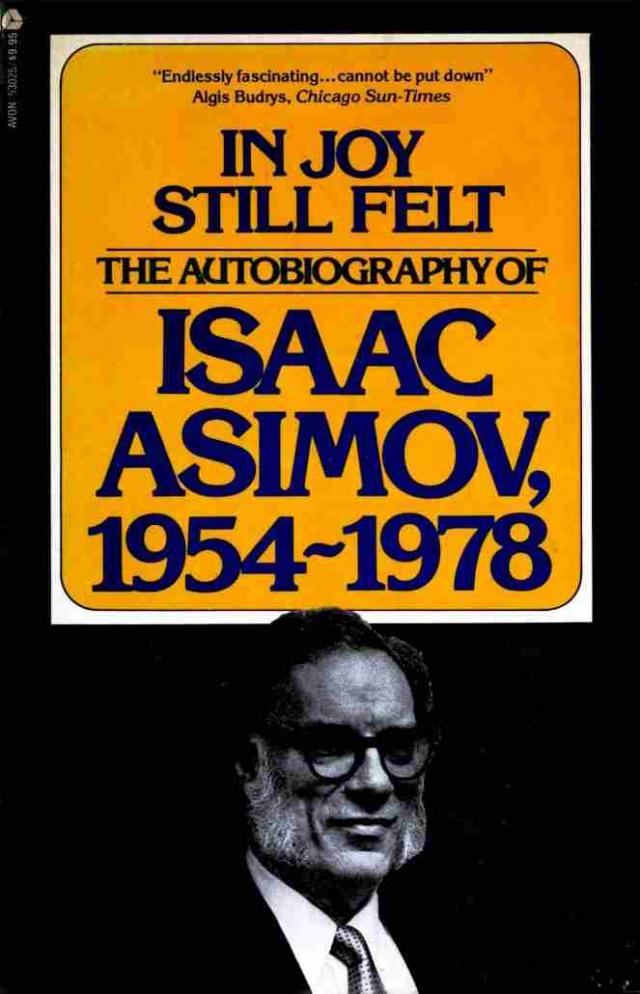
In Joy Still Felt: The Autobiography of Isaac Asimov, 1954-1978,
p.77


And in the meantime I had done, How Did We Find Out About Vitamins?, my sixth in that series for Walker.
7
Although the success at Rensselaerville and Toronto had gone some way toward making up to Janet the loss of the eclipse cruise, more had to be done. It had been over a year since I had vaguely promised Victor Serebriakoff that I would consider a trip to Great Britain, and now I decided to go through with it. On September 18, I began to check with a travel agent on possible arrangements for a round trip to Great Britain the following June.
8
The editors of The Saturday Evening Post asked me to do a story about Benjamin Franklin. It was to be a fantasy, in fact, and I was to have a conversation with him in which he and I discussed the contemporary world situation.
I was taken with the notion. After all, I had written a book on Franklin (The Kite That Won the Revolution), and I was a great admirer of old Ben. So I agreed and wrote the story, which I called “The Dream,” on September 19. I sent it off to the Post, which accepted it without trouble.
It pleased the people at the Post sufficiently to make them want to elaborate on the idea. In the first place, on September 28, a photographer was sent to the Cromwell to take photographs of me in bed, presumably carrying on my dream conversation with Ben Franklin. They ran the photographs with the story, which appeared in the January–February 1974 issue of the magazine.
Then, the approaching Bicentennial of the Declaration of Independence fired the imaginations of the Post editors, and I was asked to do further dreams involving Ben Franklin, further conversations in which I was to develop a kind of Franklinesque wisdom calling for peace and co-operation among peoples as a way of celebrating the Bicentennial.
I favored that, too, and wrote three more three-thousand-word dreams, which I simply called “The Second Dream,” “The Third Dream,” and “The Fourth Dream.” They were published in the April 1974, the May 1974, and the June–July 1974 issues of the magazine, respectively. The names under which they appeared were, respectively, “Benjamin’s Dream,” “Party by Satellite,” and “Benjamin’s Bicentennial Blast.”
By that time, though, the Post’s dreams had exceeded all bounds. They wanted me to travel around the country in order to interview people and then to work those interviews into the dreams. That I flatly refused to do, and the scheme ended with the fourth dream. One of the editors did a fifth dream, I know, but I don’t know if anything happened thereafter.
Nevertheless, the first Franklin piece and the favorable reaction of the Post led me to begin the third volume of my history of the United States. This was to cover the Civil War and I called it Our Federal Union. I began work on it on September 26.
9
My year of official separation from Gertrude had come to an end a half year before, but negotiations for a divorce had been going on but slowly ever since. I was anxious to avoid another court battle, but to do that we would have to come to some agreement on financial settlement, as everyone must, sooner or later.
On October 7, George Michaels, my Boston lawyer, was in town, and he and his wife, Barbara, had lunch with Janet and me, and he brought us up to date on developments.
The occasion was overcast not only by the general unpleasantness of the topic, but also by the fact that, the day before, Egypt and Syria had taken advantage of Israel’s preoccupation with Yom Kippur to deliver a surprise assault on Israel.
Life went on, however. Janet submitted her novel to Houghton Mifflin on October 8, thus keeping her promise to Austin three months before. On that same day, I got the news that The Caves of Steel was under a movie option. That made two active options, since I, Robot was still under option after four years—that option having been regularly renewed.
10
I had been in touch with Robyn at her college and found that she was depressed and homesick—about par for the freshman year. Still, I felt it necessary to see her. I was slated to give a talk in Rhode Island on Sunday, October 14, and I decided to go by way of Vermont.
I drove to Putney on the thirteenth, and if Robyn was unhappy, there seemed no sign of it. She looked radiantly beautiful to me and she had a very happy dinner with Janet and me at the motel at which we were staying.
After I drove her back to her school, though, I discovered that the faint malaise I experienced during the meal was developing rapidly into a definite case of intestinal flu. By the next morning I was clearly, and badly, ill. Janet had to drive me to Cranston, Rhode Island, for I was absolutely incapable of handling the wheel.
It was the first time in my twenty-three years as a public speaker that I ever fell ill on the way to a talk.
I managed a two-hour nap before the talk, but it didn’t help much. I was forced to give the talk while running a considerable temperature. The audience seemed enthusiastic, and Janet assured me afterward that I had seemed completely normal, but I myself knew the difference between what I gave and what I could have given if I’d felt well. I had to attend a reception afterward and be as gracious as I could be without letting on that although I seemed friendly and lively as I sat there, I would fall down if I tried to stand up.
The next day we drove back to New York, with Janet doing most of the driving. At home I finally allowed her to take my temperature and I was feverish, of course, so I stayed in bed for the day. I was up and around in time to take a trip to Washington on October 17, however, and to deliver a talk there.
11
On October 20 came the Saturday-night Massacre, in which Nixon fired Archibald Cox, the special prosecutor, and the top two men of the Justice Department in a sudden coup-like attempt to abort the Watergate investigation.
Since I remembered the days of Nazi Germany and since my opinion of Nixon could not be lower than it was, I was convinced that Nixon was planning an outright dictatorship and would place the nation under martial law.
I could scarcely believe it when Nixon backed off, but I could not believe that this was the result of any ethical misgivings on Nixon’s part. It had to be only a lack of courage.
For a while, though, I was in despair, and it was at this time that the Ginn people decided to approach me on the matter of my treatment of evolution in the science series. They were losing out on adoptions because some school systems objected to the inclusion of evolution. Ginn wanted the word “evolution” omitted and “development” used instead.
Furious over the approach (as I thought) of dictatorship and repression, I decided that I would make no compromises with obscurantism. On October 21 and October 24, I sent off scathing letters absolutely refusing to agree to this. I said that I didn’t care if I didn’t make one penny out of the books, but I would not compromise my scientific integrity. If they removed “evolution” they would also have to remove my name from the books.
“Evolution” stayed. The science series continued to do poorly.
I went on to do The Solar System, the seventh in my series of small astronomy books for Follett.
12
November was an eventful month.
The matter of a divorce finally came to a climax. For months, it had looked increasingly as though there might be another trial. My lawyers welcomed it since they were certain the judge would not raise the alimony above what it then stood.
I didn’t want that. I wanted to repeat my original considerably higher offer, and my lawyers, shaking their heads at my quixoticism, did as I asked them to. Gertrude finally accepted that, and on November 16, 1973, I was divorced. It came 21 months after my separation, nearly 3½ years after I had left Newton, and 31¼ years after my marriage. The whole process had cost me $50,000 in legal fees.
Although I had wanted the divorce, it was a traumatic procedure all the way.
What made it worse was that Robyn was ill—seriously ill. It had begun only about two weeks after I had seen her at Windham College. It appeared first as a sore throat, fever, a sense of weakness. It developed into tonsillitis, and she was put in the school infirmary.
She did not improve and then they discovered that she had a low white-cell count and could not find the cause for it. Without the white cells she was in a constant state of low-grade infection.
There was no question but that she would have to have her tonsils out, but that could not be done until she had recovered from the present infection.
I kept up a constant drumfire of phone calls to the infirmary and to her doctor and finally I asked the big question. Since white cells were involved, I said, “Can it be leukemia?”
He said, “We can’t rule it out.”
I said, in agony, “Don’t say that.”
He said, coldly, “Look, man, I’ve got to say that.” He was right, of course.
Gertrude went up to Windham College, got Robyn, took her back to Boston on November 16 (the very day the divorce went into effect), and put her in Children’s Hospital. I had to fight off the superstitious feeling that Robyn was being punished for my divorce.
On November 17, even while crucial tests were being conducted on Robyn’s bone marrow to check out leukemia, I had to drive to Atlantic City to give a talk to the American Association of University Women. I never came closer to rebelling against my show-must-go-on compulsion.
But things turned better. By the nineteenth, the test had definitely removed leukemia from the list of possibilities, and under penicillin treatment Robyn began to improve. By November 21, she was home with Gertrude with the white-cell count rising, and I could breathe again and look forward to a more pleasant Thanksgiving than I had thought possible a few days earlier.
13
In fact, I could begin to think of marriage. Janet and I got our blood tests on November 21, and the next day we had the Thanksgiving feast at Chaucy’s.
Over the Thanksgiving weekend I worked on a little book that the NESFA fans in Boston wanted to put out. The next Boskone was going to have me as guest of honor and they had started the tradition of putting out a small book of writings by the guest of honor. I suggested I put together eight stories from the 1950s that I had never collected, with appropriate commentary, under the title Have You Seen These? They agreed.
On the twenty-fourth, I mailed off Have You Seen These? That day, I also bought Janet a wedding ring.
14
Janet and I had a small problem as to just how we were going to get married. Neither one of us wanted a religious wedding of any kind, and it was our idea to get a civil wedding at the Municipal Building. All our friends advised us against this, however, on the ground that the atmosphere of such a wedding was dismal and would not make for a happy memory.
We went down to the Municipal Building on November 29 to get our wedding license and we had to agree that it was no place to get married.
Fortunately, we lived just a few blocks from the headquarters of the Ethical Culture movement, and officials of that movement are empowered to perform weddings. Janet therefore made the necessary arrangements with Edward Ericson of Ethical Culture for the purpose.
Oddly enough, although Janet and I had been closely bound and very much together for over three years, almost since my arrival in New York, the prospect of actual marriage seemed to upset her.
At least when I arrived from the Cromwell for dinner on the twenty-ninth, I found Janet weeping. In agitation, I asked what was wrong.
“I don’t know,” she said. “I feel as though I’ll be losing my identity.”
I said, urgently, “Don’t look upon it as losing identity; look upon it as gaining subservience.”
It worked just as well as my remark after her mastectomy had. She burst out laughing and cried no more.
We spent the next day waiting. The wedding was going to take place in Janet’s apartment, in the living room, under the avocado tree that she had grown from seed. The only ones present aside from ourselves and Ericson were to be Al and Phyllis Balk, whom we had met at Breadloaf three years before and who would serve as the necessary witnesses.
At 4:00 p.m. all was ready. Janet had taken the phone off the hook so that there would be no unwelcome interruptions. The sun was sinking toward the horizon and reddish light shone through the slats of the Venetian blind, making parallel streaks upon the wall we faced.
The light slowly faded as Ericson spoke briefly and finally pronounced us married at 4:30 p.m. on November 30, 1973. We all drank champagne, and Janet put the phone back on the hook. She had barely taken her hand away from it when it rang. It was Austin Olney, unaware that we had just gotten married, calling to say that Houghton Mifflin would publish Janet’s novel, The Second Experiment (subject to some revision). It was the most auspicious possible beginning for our marriage.
All five of us then went out for a wedding dinner, and finally we came back to the apartment as man and wife, 17 years after our first brief meeting at the 1956 convention, 14½ years after our first real meeting at the Mystery Writers’ of America dinner, and years after I had come to New York.
15
As a newly married man, once again, my first piece of writing was “The Second Dream” for The Saturday Evening Post, and my first social engagement was lunch with Lester and Judy-Lynn on December 2.
My first speaking engagement was on the evening of December 2, when Janet and I drove out to South Orange, New Jersey, to talk at Temple Israel.
I introduced Janet very proudly as my wife, and to Janet’s mortification this meant she was promptly backed into a corner and made to listen to chatter about children and the PTA.245
The rabbi was delighted at hearing that we had been married on Friday at sunset. He said, “You married as the Sabbath arrived. That is a very good omen.”
On December 4, I visited Family Health to discuss an article they wanted me to write (which I never got to, as it happened) and they brought up the matter of another article they had asked me to write over half a year before.
They had, at that time, asked me to do an article on some medical emergency bravely met and endured by myself or by some member of my family. I had said at the time that the only example I knew personally was Janet’s mastectomy, but I didn’t want to write about that until after we were married, since the story would not have a happy ending unless I could prove it did not prevent the marriage.
At our December 4 meeting the editor said, “Where do we stand on your fiancée’s mastectomy?”
I said, “We married four days ago. I can write it now, provided she gives her permission.”
Janet hesitated, quite naturally appalled at having her misfortune spread over the pages of a magazine. I made two points, however:
First, the story of the successful survival, emotional as well as physical, from such an operation might help others.
Second, to describe the survival, without once mentioning God as either cause or refuge, might be a blow for humanism.
She agreed, and even added a few paragraphs of her own, under the name “Janet Asimov.”
The article, entitled “Mastectomy: A Husband’s Story” appeared in the December 1974 Family Health, while Janet’s addendum appeared as “Facing Up to It.”
16
While Robyn’s illness and my own divorce and remarriage filled the last months of 1973 for me, I could not help but be aware of the energy crisis. In the wake of the Yom Kippur War, the Arab bloc had imposed an embargo on oil shipments to the United States, Japan, and western Europe, and a confused American public suddenly found itself queuing up at gas pumps.
Not only did this raise questions in my mind as to how I was going to reach those places I had to reach in order to give talks, but also I was suddenly bombarded with requests to write articles on various aspects of the energy crisis.
My own favorite article of that type was the one I wrote, unrequested, for F & SF. It was my 188th essay, entitled “The Double-ended Candle,”246 and was published in the June 1974 F & SF.
17
Comet Kohoutek was coming. Through the last months of 1973, it had been expected eagerly, for it had been sighted so far out in the solar system that it was clearly a large comet that might be making its first pass through the inner solar system.
This meant it might be a bright one, if it were of appropriate composition, icy, rather than rocky. Naturally, the dramatic assumption was that it would be icy and brilliant.
A half year before I had written an anticipatory piece called “Watch for the Christmas Comet,”247 which had appeared in the December–January 1974 issue of National Wildlife. I had been cautious enough to qualify and say, “Comet Kohoutek, on its way now, may prove to be a superbright . . .” Despite the inclusion of that careful “may,” I believed that it would be superbright.
Consequently, when it was announced that there would be a three-day “Cruise to Nowhere” on the Queen Elizabeth 2 to see the comet at its peak, I eagerly signed up. Again, it would make up to Janet a little for her having missed the eclipse cruise. Besides, it would serve as a honeymoon trip.
We embarked on December 9 and it was the first time on the QE2 for either one of us. Janet, who loved all ships, promptly formed a lasting attachment to this one.
The weather disappointed us. It was cloudy and rainy wherever the QE2 went, and no one ever had a chance to look at the comet. This, as it turned out, was just as well, for Comet Kohoutek was a terrible disappointment. At its brightest it was barely visible to the naked eye, since it did not, after all, have the proper composition. It was too rocky to be bright.
Janet and I didn’t care. We were in a state of honeymooners’ bliss, walking about the ship so entwined that it’s a wonder we didn’t trip over each other’s feet.
We attended the various lectures, and on December 10 we entered the auditorium to hear Kohoutek himself. As we sat down, Janet said, “It’s so good to go on a trip just to enjoy ourselves; one where you don’t have to work and give a talk.”


