

In joy still felt the au.., p.76
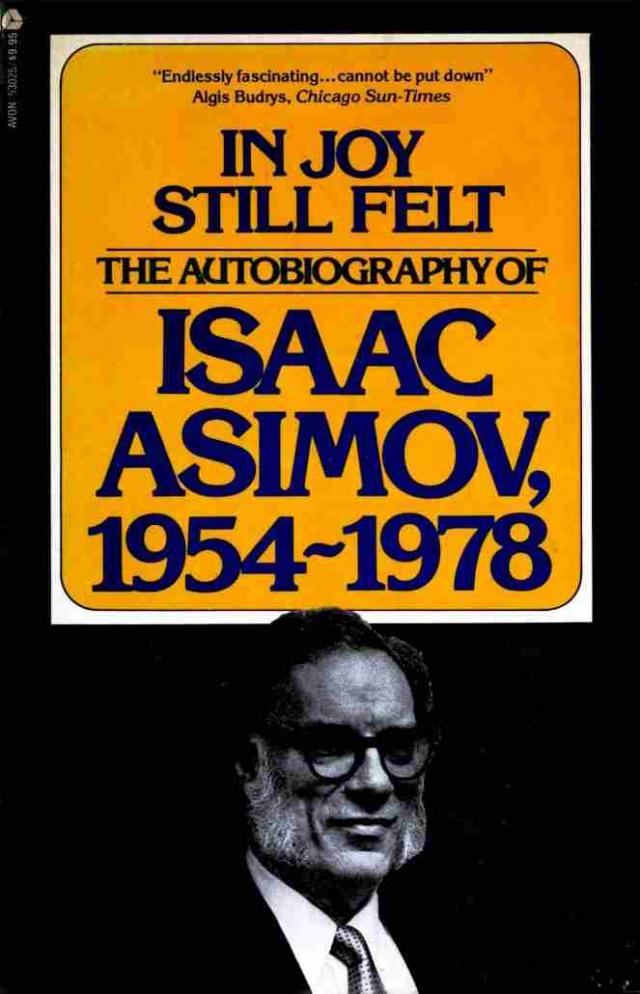
In Joy Still Felt: The Autobiography of Isaac Asimov, 1954-1978,
p.76


Janet was back in her apartment on the twenty-ninth after eleven days in the hospital, and I talked to her there. She had the services of a live-in nurse, so I felt she was secure.
22
On June 30, it was eclipse time. A sandstorm over the Sahara produced a windblown sand haze in the sky and there were clouds besides. The Canberra, however, managed to find a place where there was a hole in the cloud cover, and all over the decks of the ship, tripods and telescopes and cameras had sprung up overnight like a growth of weeds. I was one of the few without equipment of any kind.
The sight of the total eclipse was wonderful. There were two things that were unexpected. The eclipsed Sun, with its corona spectacularly visible, looked smaller than I expected, and at total eclipse, it did not seem to be night but, rather, twilight.
I was excited enough to be shouting wildly at the moment of eclipse. There were people there with tape recorders, and I was allowed, afterward, to listen to the deathless prose that issued from my lips.
One exclamation was, “Yes, that’s it. That’s it. That’s the way it’s supposed to look,” as though I were congratulating the cosmic director who was running the show.
The other, when the brighter stars began to be visible was, “That proves it. The stars do shine in the daytime.”
To me, the most exciting split second was the reappearance of the Sun. For five minutes of totality we waited and then at the western edge of the Sun there was a flash of light. The “diamond ring” effect lasted for a bare moment. The blaze broadened, and in two seconds one could not look at the Sun anymore.
The whole thing was a spectacular success. Now, if anyone ever asked me to write a description of a total eclipse, as Look had asked me to do, four years before, I would be an experienced person in the field.
23
Yet there was something that was, for me, an even more exciting moment.
There were musicians onboard ship who were arranging an amateur musical show in honor of the Fourth, and I went up to watch rehearsals. At one point, I couldn’t help but sing along in a very low voice. It wasn’t low enough.
Someone came up and said in surprise, “Do you sing baritone?”
“Of course,” I said. (The surprise was natural. My speaking voice tends to be tenor.)
“Sing this, then,” he said, and thrust a piece of sheet music into my hands. Apparently he thought I could read music.
I put it away and said, “Tell me the words and play the music.”
He played it on the piano and sang it after a fashion. Then he said, “Now you.”
I sang it while he held his breath to see if I could make the high note—which I reached effortlessly—and thereafter I was part of the rehearsals—and was full of stage fright.
On July 4, we put on our show, and finally I sang “Dear one, the world is waiting for the sunrise. . . .” to thunderous applause and considerable surprise. Many people thought I was mouthing the words while it was being sung on a record player.
On July 7, there was another showing, and I not only sang “Dear one,” but also “Old Man River” as an encore. Then when they wanted still more, I rebelled, and said I did not want to sing baritone anymore, but would sing tenor. I sang “Venezuela” (which I had heard in Chester’s Zunbarg, twenty-five years before) at the top of my range.
That was really a triumph. I sang both baritone and tenor to the same audience on the same evening and did it well each time. It’s a good thing I’m a compulsive writer. Otherwise, wild horses wouldn’t have kept me out of show business.
24
We docked in New York at 9:30 a.m. on Sunday, July 8, 1973. The Siglers arranged to have customs go through my baggage onboard ship, but when I tried to get off I was stopped. No one would be allowed to disembark, I was told, till all the baggage was removed, and that would take hours. I tried to explain that I was carrying my own baggage and that it had already been checked by customs and that I had a piece of paper to prove it. No one would listen.
I waited about fifteen minutes and then, driven mad by the fact that I could see the apartment house, I got my baggage and marched off the ship, disregarding the official who was shouting after me, presented my paper to the customs people, and got a taxi. I was in Janet’s apartment at 11:15 a.m., hours before anyone else on the ship got off.
Janet, whom I now saw for the first time in sixteen days, seemed quite herself, though weak.
25
Eventually, I went to the Cromwell and found that, in my absence, a new door had been placed on my apartment (part of the shift from hotel to apartment house) and that the new girl at the switchboard knew nothing about any key for it, or any mail that might be waiting for me. She didn’t even know that I was living there.
I had to wait till the next day before things returned to normal.
On July 17, the progress of the Cromwell changeover reached the point of an imminent abandonment of the switchboard. I had a private phone installed, therefore. It saved me the trouble of having people go through the switchboard (which was sometimes troublesome to reach). On the other hand, it meant I had no one to ward off my calls when I wanted that done, and I had no one to take messages. I therefore hired an answering service, the same that Janet used.
As a result of the cruise, by the way, I wrote two F & SF articles, my 183rd and 184th, entitled “The Eclipse and I” and “The Dance of the Luminaries.”242
At the annual meeting of the Baker Street Irregulars, January 4, 1974. To my left is Robert Fish, to my right Banesh Hoffman. Directly above Fish is Edgar Lawrence.
Robert Stack and I on “The Mike Douglas Show,” about 1973.
Bookstore window in London during my 1974 visit there.
The 1976 Lunacon. Typical shot of me at a science-fiction convention. That’s Ted White, at that time editor of Fantastic and Amazing magazines, to my left with the “guest” Badge on. Photo by Jay K. Klein.
In 1976 at home, standing in front of a bookcase containing hard-cover, English-language of my books, in chronological order, no exact repeats. Photo by Jay K. Klein.
Left, Victor Serebriakoff, me, Marvin Grosswirth: Mensa bigshots on June 22, 1976.
In 1976, in my library home.
Commencement address. Haverford College, May 17, 1977. Next day is my coronary. Photo Edward J. Bonner.
Receiving the Hugo for “The Bicentenial Man” in late 1977.
Cover of the first issue of Isaac Asimov’s Science Fiction Magazine.
Part V
–
Ageless Love and Aging Heart
38
Second Marriage
1
Judy-Lynn was no longer with Galaxy, but had joined the staff of Ballantine Books. There, one of her duties was the editing of anthologies of original stories, and she was after me to do a story for her.
On July 22, 1973, I began “Stranger in Paradise” for her, completed it on the twenty-ninth, and handed it to her. It was a sizable effort, ten thousand words long, and she promptly rejected it!
With considerable indignation, I took it over to Ben Bova on the thirty-first, and later that day he called me and asked me if I were sitting down. Rather irascibly, I answered that I wasn’t.
“Well, sit down,” he said, and then he rejected it, too.
I retired the story in considerable agitation. The growing speed with which my experience and position had made it possible for me to write stories and get editorial decisions meant that in the space of merely ten days I was able to write a novelette and get two rejections—and from my closest friends, too. It was the first shorter piece of fiction that had been rejected by more than one editor in thirty-one years; the last had been “Victory Unintentional.”
It might have been a more significant blow and affected me more deeply were I not so prolific. As it was, all my other projects were doing well.
2
Janet’s birthday was approaching and I was anxious to make it a good one. The year before she had celebrated her birthday in the hospital and had missed Breadloaf later in the month. Then this year she had been hospitalized again and had missed the eclipse cruise. Insofar as one could make up for all that, I would try to arrange it.
The day before, Sunday, August 5, I made my weekly phone call to my mother. I had hoped she would not have noticed that the day before was the fourth anniversary of my father’s death, but she had noticed it and was very sad. I did my best to console her and promised I would be visiting her very soon, but she wept at her loneliness without him.
And then came August 6, Janet’s forty-seventh birthday, and at the Cromwell I did one or two things I could not neglect and then rushed to Janet’s to begin the celebration.
At least I began to rush over, but even as I was leaving the door, the woman at the switchboard (which was in its last weeks of existence) called out that there was a phone call for me.
She hooked me in to the phone in the lobby and it was my sister, in tears. She had just been called by the police. My mother was dead. She had died peacefully in her sleep in the early hours of the morning, and some member of the family would have to identify her or she would be taken to the morgue. My brother couldn’t be reached (it turned out that he was off playing tennis with Ruth), Nick was at work, and Marcia was too unstrung. I assured her that I would go.
I went to Janet’s apartment, then, in a somber mood. “I’m sorry, Janet,” I said, “but the birthday will be a lousy one again. My mother just died.”
Janet brushed aside her birthday as of no consequence, commiserated with me, and together we drove out to Long Beach. I identified my mother for the police and I remained till the medical examiner arrived to certify a natural death, and the people from the funeral home arrived to remove the body.
My mother had died four years and two days after my father, and just one month short of her seventy-eighth birthday.
Her death didn’t affect me as badly as my father’s had. The slow deterioration of her health had made the event inevitable, her sad and lonely life without my father had made it welcome to her, and I had to recognize that prolonging its meaninglessness was not what she wanted.
Soon after my mother’s body was removed, Stanley and Ruth, and then Marcia and Nick, arrived.
Stanley said he would take care of the bills and details in connection with the hotel in which my mother had been living. He was the executor of the estate and knew the terms of the will. Since we three children were the only legatees, Stanley suggested that we remove my mother’s belongings from the apartment now, arrange some of the stuff for disposal to charitable agencies, and divide the rest.
I could not bear to take part in the division. I did take one ballpoint pen (I cannot resist pens), but nothing more. Stanley and Marcia divided the rest in perfect amicability.
While that was taking place, my deep depression stirred the inevitable gallows humor within me and I said, suddenly, “If Mamma had only known that all six of us were going to be here today, she would have waited.” It got a rather hysterical laugh.
My mother was eventually buried in the plot just next to my father, and the headstone had an additional date carved into it.
Nor was there any trouble over her will. My mother had insisted, over my protests, on leaving everything to her three children, divided into equal thirds. I had told her that I didn’t need any money and to cut it into equal halves for Stanley and Marcia, but she wouldn’t even consider cutting me out of the will.
After her death, I told Stanley that I would not accept my share and that he was to arrange to have it divided into two for himself and Marcia, making whatever legal arrangements were necessary. I said I wouldn’t even take my share long enough to give it to them, lest that involve tax problems.
Stanley arranged matters with his lawyer, who sent me a letter suggesting I get a lawyer of my own to protect my interests.
I replied that I needed no lawyer since I had no interests that could conflict with Stanley’s.
The lawyer asked Stanley if it were possible I really meant that and Stanley assured him that he and I took the business of being brothers quite seriously.
3
I kept myself busy with work on Eyes on the Universe, and on August 14 I began my sixteenth Black Widowers story, “The Three Numbers,”243 which sold instantly (despite “Stranger in Paradise” I had not lost my touch). It appeared in the September 1974 EQMM under the title “It’s All in the Way You Read It.”
Then, on August 19, Janet and I went to Rensselaerville, where we had had such a pleasant time the year before. This time I was, in a sense, fulfilling the Duncan MacDonald role and running the discussions, which were based on ethical questions arising from my science-fiction stories. The weather was perfect and it was all much more like a vacation than a seminar. For Janet, particularly, the surroundings were ideal.
While we were there, David turned twenty-two, and my present to him was the money with which to buy an automobile for himself.
4
We were home on the twenty-third and prepared for the thirty-first World Science Fiction convention, which was to be held in Toronto. That was a little far for me, but The Gods Themselves had been nominated for a Hugo and I wanted to be there on the chance that it might win.
En route we stopped off at Niagara Falls, where I had the odd sensation of being a seasoned traveler. Janet had never seen them, but it was my third visit there, and I squired her around. By the afternoon of August 31, we were in our hotel in Toronto.
The Hugo awards banquet was on the evening of September 2, 1973, with Bob Bloch giving the guest-of-honor speech and Lester del Rey toastmastering. The Bovas and Pohls were at our table, along with Gordon Dickson.
It was a prize-winning table, indeed. Ben won the Hugo for best editor, and Fred Pohl won in the best-short-story category for a story he completed that Cyril Kornbluth had once started. Fred therefore had two Hugos, one for himself and one for Cyril. And, of course, I won the Hugo for the best novel, thanks to The Gods Themselves.
Afterward, I went up to Ben Bova’s suite to help celebrate. I had promised Janet, who favored early-to-bed, since we would be on the road the next day, that I would only stay for fifteen minutes. After an hour had passed, however, she called to make sure I was all right, and we begged her to join us.
In ten minutes more there was a knock at the door and I said, jubilantly, “Janet is here” and threw the door open, dashing through.
Ben opened the real door to let Janet in, while I emerged, shamefaced, from the closet. Ben at once gleefully informed the assembled multitude that “the greatest mind in science fiction” couldn’t tell a closet door from a hall door.
We did leave the next day and were home by September 4.
5
On September 5, I heard from Robyn. She was at Windham College in Putney, Vermont, and was beginning her college career there. She had given away Satan before she left for college, and we would see him no more. (And on that day, my mother would have been seventy-eight had she lived.)
Meanwhile, Janet had finished her science-fiction novel, The Second Experiment. That might never have happened but for her siege in the hospital with her subarachnoid hemorrhage. Filled with a sense of the briefness of life, she decided she just had to use the summer to get the novel done.
Then, too, once again Austin had come in from Boston and visited her in the hospital while I had been off on the cruise. Her memory had improved to the point where she seized the opportunity to tell him the plot of the novel. He had been interested and had urged her to finish it and let him see it.
On September 11, Janet handed a copy of the novel to Ben Bova for possible serialization. Ben rejected it, but found much good in it and suggested a rewrite. I persuaded Janet to try it on Houghton Mifflin before revising, and get a second opinion. Doubleday was the logical choice, actually, since Houghton Mifflin did no science fiction (except for Fantastic Voyage), but Austin had expressed interest in seeing it, and it would be only courteous to let him see it.
6
While I had been at the Toronto convention, word had come to us that Tolkien had died. I had by then read the Lord of the Rings series three times with great pleasure and had, moreover, a certain feeling of guilt at having beaten it out for a Hugo seven years before.
I decided, therefore, to write a seventeenth Black Widowers story centered about Tolkien as my way of showing homage. I called it “Nothing Like Murder”244 and took it in to EQMM on September 17. Not entirely to my surprise, it was rejected. Fred Dannay quite rightly pointed out that his readership was not likely to be sufficiently acquainted with Tolkien to make the story a fair one for them.
The story did not remain retired for long, however. A month later, Ed Ferman asked if f had a story for him by any chance. I said that I had a story based on Tolkien, but it was neither fantasy nor science fiction. He asked to see it and on October 11, I mailed it to him. To my considerable surprise, he took it and it appeared in the October 1974 F & SF. It was the first Black Widowers story to appear anywhere but in EQMM.
I waited for loud complaints from the F & SF readership, but they did not come, and Ed eventually told me he would welcome additional Black Widowers stories now and then, if they had some sort of scientific theme.


