

In joy still felt the au.., p.51
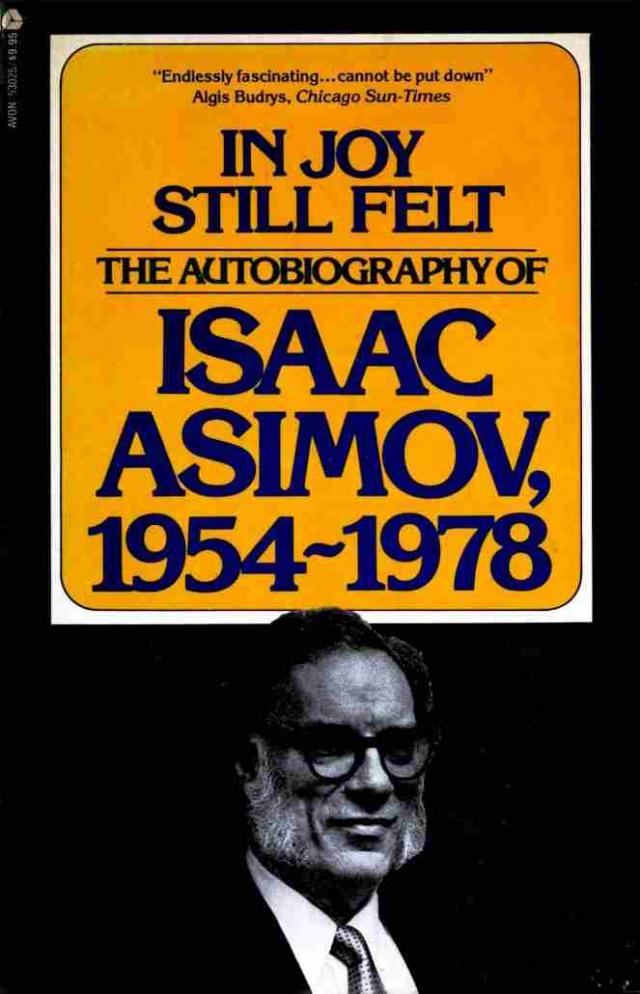
In Joy Still Felt: The Autobiography of Isaac Asimov, 1954-1978,
p.51


We must have made a curious sight as we barreled down the Massachusetts Turnpike—a tiny car with two beautiful young women filling it completely and the head of a middle-aged man poking out from between them.
As we approached the first toll booth, I called out, “Pay the money, girls, and I will pay you back when we get to my house.”
“We don’t have any money,” they said.
“No money?” I said, stupefied. “How can you get by without money?”
“Oh, someone always helps out,” said the driver, cheerfully.
That remark offered me an insight into the strange world in which beautiful young women live. I struggled to get out the necessary coins. It was very difficult, weighed down as I was by 140 pounds of female flesh and blood, but it had its compensations.
When we were finally home, I invited the young women into the house for Cokes and called out to Gertrude to say hello.
She wasn’t there; she had gone out shopping. I hadn’t expected that. I turned uneasily to the young women and said, “My wife’s out shopping. I’m sorry, but I honestly didn’t know that the house would be empty. We’ll leave.”
“That’s all right,” they said, coolly, “we’ll have our Cokes.”
I wasn’t sure that it was flattering to have them so completely certain that I was entirely harmless, but I served them their drinks.
15
Howard Gotlieb, my curator at Mugar Memorial Library, had decided to put up a display of Asimov books, presenting a copy of every single one, some in different editions, all suitably inscribed, and in chronological order from 1 to 80.
The only book he didn’t have and couldn’t get was The Death Dealers. Howard appealed to me, and I was helpless. I had no spare copies at all, only my own library copy, which I had had bound in hard-cover.
Howard pleaded for it and, very reluctantly, I let him have it, asking him over and over again to guard it with his life. He promised, and put it prominently in one of the cases, along with a card describing it as a very rare copy, personally bound by the author, but as otherwise existing in paperback form that was out of print and could not be obtained.
On April 27, 1967, there was a formal opening of the display eighty books in seventeen years, an average of five a year. Many people from Houghton Mifflin showed up, including, of course, Austin, Mary K., and Walter Lorraine. To my surprise, Sam Walker of Walker & Company arrived. He was in Boston on some errand or other and took the trouble to drop in; I was pleased and touched.
16
Robyn was growing up. We had frequently taken walks together, going hand in hand here and there in the neighborhood, talking and skipping and joking and singing.
Now things were slacking off. She began to disapprove of my more elaborate effervescences and finally demurred at taking walks with me altogether.
“Why not, Robyn?”
“You’re my father, Daddy.”
“Of course I’m your father. That’s why we should take walks.”
“No. The girls might see me.”
“So what?”
“You’re not supposed to walk with your father.”
“Why not?”
“Because the girls don’t do it.”
“Who cares? We do.”
“Well, we shouldn’t.”
And we didn’t. She had grown too old for it. The trouble was, I hadn’t.
17
And then things grew worse. On May 1, Robyn broad-jumped at gym in school, breaking the school record, but landing so hard that she apparently sprained her right ankle and couldn’t stand on it. As they carried her off, she called out, “Did I break the record?”
That, I suppose, was the true mark of the achiever, but she should have asked, “Did I break my leg?” because she had.
We took her to the Newton-Wellesley hospital, where they X-rayed her ankle and found she had sustained a hairline fracture of the tibia just above the ankle. It was a tiny, unnoticeable break, but on went the cast just the same and it would stay on, said the doctor, for six weeks.
I was in despair. It was the first broken bone to anyone in my immediate family in my whole life, and I tried to drown my unhappiness in work. There was a little astronomy book for Follett, Galaxies, and I put together some stories of mine for New English Library, a British firm. The collection was called Through a Glass, Clearly, and it was for distribution in Great Britain only.
18
By May 3, Robyn seemed quite herself, except for the broken leg, of course. In fact, she seemed pleased at the romantic position of being in a cast and getting some time off from school, so I took a chance and made the trip to New York that I had been planning for the fourth.
I had a long lunch with Larry on that day and he wondered if I’d ever considered doing an autobiography. I admitted I had been thinking of doing one for years but always came up against the difficulty that my life had not been an exotic and unusual one. “But someday I will,” I promised.151
At Walker & Company, Sam Walker, having gone over the exhibit of my books at Mugar Memorial Library the week before, inquired of me concerning The Death Dealers. He had noticed that it had appeared only in paperback and that it was now out of print.
Might it not be possible to do a hardback copy of it, he wondered? I was delighted at the thought. My failure with The Death Dealers was somehow the literary equivalent of my failure to get into medical school, and I wanted another chance.
Of course, I would have to seek a reversion of rights from Avon, but I didn’t think that would present any difficulties—and it didn’t.
19
When I returned to West Newton, I found Robyn, to my relief, still in high spirits. In fact, on May 8 she returned to school by taxi (one would be provided every day in consequence of her having suffered the injury in the course of a school activity—I had paid insurance for that privilege), and that added mightily to her sense of importance.
On that same day, I gave a talk for a group organized by my friend Arthur Obermayer. He knew me well enough to have it at Boston’s Playboy Club, and that marked the first time I had ever been inside the halls of such an institution.
I found the bunnies very delightful indeed, but apparently Arthur knew me well enough to have arranged for all the bunnies to vanish after dinner, when I was to give my talk.
20
On May 24, I began a new book for Basic Books, where I was now working directly with Arthur Rosenthal, the publisher. I suggested doing a book on photosynthesis—which would give me a chance to do biochemistry. He was willing and I used Photosynthesis as my working title.
Somehow I took it for granted that by the time the book rolled off the presses, it would be called The Green Miracle or The Food Factory or something like that. It wasn’t. It came out as Photosynthesis. In fact not only was the word on the cover, but it was also repeated four times, one under the other, as though printing a Greek-derived five-syllable word four times made it any easier to pronounce or understand than if it had been printed only once.
“Arthur,” I said uneasily, “how can the book sell well with that ridiculous title?”
Arthur said, “It’s got a good book jacket.”
It did. Under the quadruple title was a photograph of the Sun, peering through a tree in full leaf. “That is a good photograph,” I said.
“I’m not talking about the photograph,” said Arthur. “If you’ll look under the photograph, you’ll see your name printed very clearly—and spelled correctly.”
It was nice to have a publisher’s confidence, and, indeed, the book did moderately well.
21
The month of May was ending in absolute chaos. Robyn was still in her cast, of course, and Gertrude, who had been suffering chronically from arthritis, suddenly began a siege in which it was acute. She could scarcely move. On top of that, John Blugerman called from New York to tell us that Henry Blugerman had lung cancer and would have to be operated on.
Naturally, that would be the month in which my speaking schedule was particularly heavy. Seven talks had been scheduled, and the final one was on May 31. It was to the American Heart Association in downtown Boston.
That morning a friend called, and when he remarked on the sadness in my voice, I seized the chance of listing my woes. I ended by saying, “The only one around here beside myself who isn’t in a bad way is David. Thank goodness, he’s in good health.”
I then hung up and I hadn’t as much as removed my hand from the phone when it rang. I answered and (you’re ahead of me, I know) it was from the school to tell me that David was running a slight temperature and was being sent home.
I would have liked to cancel the talk that night, but you can’t do something like that. Talks were show business to me, and the show must go on. Nevertheless, I was too upset to feel I could be trusted at the wheel of my car. I called a taxi and had it take me downtown.
There was a cocktail party first and, for the first time in my life, I deliberately had three drinks in an effort to get high before giving my talk. I felt I would not be able to give it cold sober. Perhaps because I had the need to get drunk (or thought I did) the drinks did not affect me at all as nearly as I could tell.
I got up to give the talk, sober—and found I did not need the drinks after all. The act of speaking elated me. In fact, I found so much relief in speaking, and felt so removed from all the disasters of the month, that I did not want to stop. I knew that when I stopped all would come back to me.
I continued fifteen minutes longer than I ought to have, and if I thought I could have persuaded them to listen, I would have spoken all night. As it was, it was one of the best talks I had ever given.
Then, of course, things improved. By the next day, David’s fever was gone, Gertrude’s arthritis cooled down to the point where she could leave the house—and on June 2, Robyn’s cast was removed.152
22
I was waiting for my new car, and rather than use the old one, I drove to New York on June 8 in Gertrude’s Barracuda, which handled like a dream. When I arrived in New York, I called home and found that the new Ford was waiting at the dealer’s.
It was just as well. Had the new car come a day sooner, I would have been tempted to drive it to New York, and it made more sense to drive it about locally and work out the bugs before risking it on a long trip.
All was going smoothly with respect to The Death Dealers. Avon allowed the rights to revert to me, and Walker & Company gave me a contract.
On June 9, I visited Henry Blugerman in the hospital. He seemed in good spirits as he waited for the operation, and I was glad of that, for he was a gentle, kindly soul beloved by all.
23
On June 13, I finally picked up my new Ford. It was the fifth automobile I had bought and I felt rather inordinately wealthy with two 1967 cars in my garage.
More important was the fact that on June 15, Henry survived what seemed a successful operation. One lobe of his left lung was removed and the doctors expressed the hope that there might be a complete recovery. Henry was seventy-one years old at the time and it seemed reasonable to hope for another decade of life.
And meanwhile I had written my 109th F & SF essay, which eventually appeared in the November 1967 issue of the magazine. It was the 17th essay of a new series and I promptly began putting together a sixth collection, to be called Science, Numbers, and I.
24
There was a change of editors at Hornbook. This seemed a chance at last to end a duty I was finding increasingly onerous. I had not wanted to abandon the previous editor, Ruth Hill Viguers, who had brought me in as reviewer, but with her gone, there was no reason I needed to continue. I had been working on the column for nine years now, and enough was enough.
Nor did my conscience hurt me. I suggested Harry Stubbs as a successor, and he agreed to serve. Harry was much better at it than I was. He read the books more carefully and thoughtfully than I did, and anyone who read his columns could see that he enjoyed preparing them more than I did.
25
The appearance of Fantastic Voyage in The Saturday Evening Post had belatedly filled me with the ambition to get something of mine into the dying shadow of that magazine before it was too late. I wrote a fifteen-hundred-word short-short for that purpose, one I called “Exile to Hell,”153 and I sent it in on June 21, 1967.
I was rejected, however, just as I would have been by the Post in the 1930s and 1940s. Only then did I begin to remember my neglect of Campbell. In the ten years that had elapsed since he had published “Profession” in the July 1957 Astounding, I had sent him only one piece of fiction, and that was “Thiotimoline and the Space Age,” and that was only semifictional at best.
Feeling like an ungrateful hound, I sent in “Exile to Hell” to Campbell and he took it. For old times’ sake, I was delighted. It eventually appeared in the May 1968 Analog (the first bit of fiction of mine to appear in the magazine under that name) with a typical Campbellesque blurb that gave away the point of the story.
26
Time magazine was noticing me. A reporter came to interview me on June 26, and two days later a photographer came to take pictures for the magazine.
The July 3, 1967, issue then carried the story—two columns, along with a good-looking and dignified photograph of myself. Time treated me with considerable praise, including some quotations from myself in which I treated me with considerable praise as well.
According to Larry Ashmead, one of the Doubleday editors rushed into his office and said to him jubilantly, “Have you seen the story on Asimov in Time? It’s filled with charming Asimovian immodesties.”
For years thereafter, I used the phrase “charming immodesties” to refer to my own estimates of myself, until I found the phrase “cheerful self-appreciation,” which suited me still better.
Another spinoff rested on the fact that Boston University had just gained a new president, Armand Christ-Janer.154 He had just taken office on July 1, and in his first week, while leafing through Time, he found one of his faculty featured there.
He sent me an excited hand-written note, which I received on July 9, and on July 20, at his invitation, I went to the main campus to see him. We spent twenty minutes together and he told me (according to my diary) “how grateful BU is to be associated with me.”
I thanked him and smiled to myself at the thought of how the situation had changed in the ten years since my struggle with Keefer.
26
Asimovian Immodesties
1
I had lunch with Tim Seldes and Wendy Weil in New York on July 7, 1967, and that was one of the occasions on which an event took place that fueled the rumor that I have a photographic memory. (I don’t. It’s just a pretty good memory.)
It seems that I had once read in The Historians’ History of the World that Abd er-Rahman III, the greatest King of Muslim Spain, who had reigned fifty years with great success and prosperity, had confessed that in all that time, he had had only fourteen happy days. It seemed a remarkable commentary on the human condition, and I remembered it—especially since I myself had had far more than fourteen happy days.
A couple of weeks before my lunch with Tim and Wendy, I had bought a paperback book of quotations edited by George Seldes, Tim’s uncle. I like books of quotations and tend to buy them when I see them. This one, however, was filled with quotations that were expressed in such turgid and unmemorable prose that (even though I agreed with I virtually all the liberal sentiments) I threw the book away.
It did, however, have the Abd er-Rahman III quotation under “Happiness.” It went something like this: “I have reigned fifty years at the height of prosperity and power, loved by my friends, respected by my subjects, and feared by my enemies, yet in all that time I have known but fourteen completely happy days.” I noticed that quote because until that time I had thought I was the only person in the world who knew it.
At the lunch I said to Tim, “I just bought your uncle’s book of quotations.”
“Really,” said Tim, “and did you notice the mistake in the very first item?”
Well, I hadn’t. I knew that Tim asked me that only to puncture the rumor that I had a photographic memory, and the fact was that I hadn’t the faintest idea what the first item in the book was. Thinking rapidly, however, I recalled that in the Introduction to the book (I read Introductions) it stated that the paperback (which I had bought) differed from the hard-cover edition in listing quotes alphabetically by subject rather than by author. If in the hard-cover the listing were alphabetically by author, then the Abd er-Rahman III quote was probably first.
Thinking that through took only a few seconds, so when I said, calmly, “Yes, I did,” it sounded as though there had been no pause at all.
Tim said, disdainfully, “You’re bluffing. You don’t even know what the first quotation was.”
“Yes, I do,” I said. “It was Abd er-Rahman Ill’s statement: “I have reigned fifty years . . .” and I completed it with reasonable accuracy.
Both Tim and Wendy were now staring at me, and Tim said, “And what was the error?”
“Although Abd er-Rahman III is quoted as saying he reigned fifty years, they give his dates of his reign, and he died after reigning only 49 years,” I said (having happened to notice everything about that fascinating quotation). “That’s not really a mistake, however. He was counting the years by the Mohammedan lunar calendar, in which there are only 354 days to the year.”


