

In joy still felt the au.., p.20
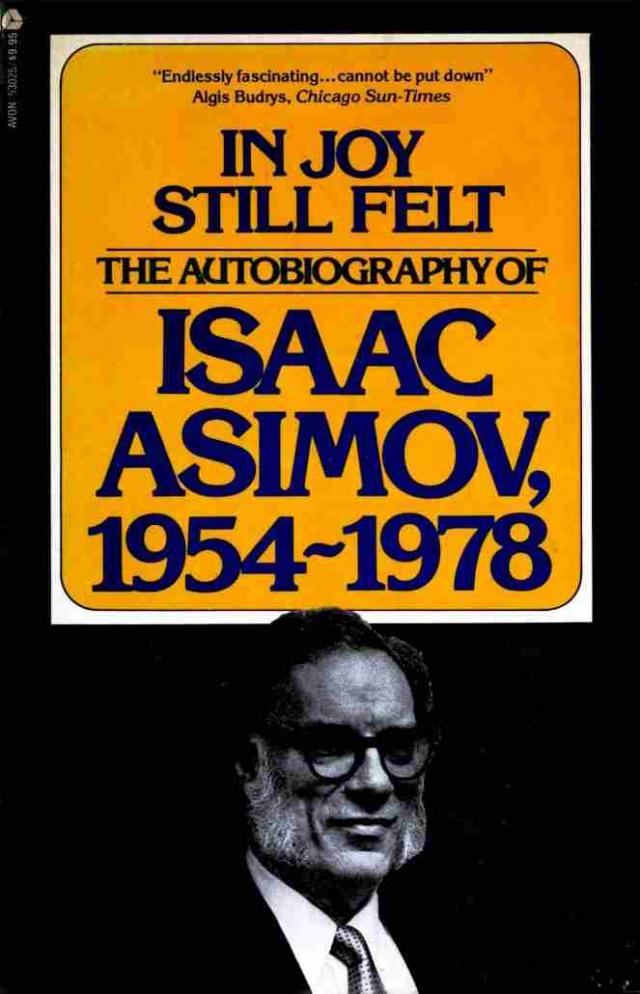
In Joy Still Felt: The Autobiography of Isaac Asimov, 1954-1978,
p.20


So let me keep my promise and say what I think of these gentlemen in my autobiography. I hold no malice or bitterness over the matter. I enjoyed the fight and I won it, and by relieving me of my school duties they did me a favor. Where, then, should the malice or bitterness come in?
I feel, looking back on it, that Henry Lemon misjudged the effect of my profession on the school and sincerely and honestly felt it would be for the good of the school to get rid of me. I feel that working with what seemed to him to be worthy motives he influenced Chester Keefer into thinking it was important to get rid of me. I feel that F. Marrott Sinex, new at the job, had no choice but to go along with Keefer.
Except for those three and for that short period of time, no one at Boston University at any time has treated me with anything but the greatest respect and friendship. And even Sinex, in the years since that fight, during which he remained the head of the department and my titular boss, never treated me with anything but the greatest respect and friendship.
I have, therefore, no fault to find with anyone or anything.
Part II
–
The Book Race
11
Peace
1
For the first time in a long while, peace descended—no job worries, no housing worries, no pregnancies. It is nice to have such interludes now and then.
We got David his first bicycle on May 7, 1959, at which time he was still some months short of his eighth birthday. It was somewhat less than regulation size so that his feet could reach the pedals.
Like Stanley before him, he had no trouble. I anticipated training wheels, or having to walk or run beside him, but no such thing. He got on it and off he went.
It made me think that if it were that easy, I had to be able to master the device, so I got on briefly—but only briefly.
That night, however, I felt as though I had gotten onto another kind of bicycle, but one that I couldn’t easily get off. It involved Norbert Wiener.
At some dinner party (the details are not, alas, in my diary) Norbert told me he had read The Death Dealers and had liked it. My heart warmed to anyone who would give me a kind word for the book, and Norbert’s praise was so extravagant that I would have popped my vest buttons if I had worn a vest.
But then it turned out that Norbert wanted to write a mystery of his own and had a collaboration in his mind, so I couldn’t tell how much of his praise was sincere and how much was policy. I took to avoiding him after that because, to be truthful, I didn’t in the least want to collaborate on a mystery with him.
On the evening of May 7, though, I saw him perforce. It was at an initiation dinner of Sigma Xi, over which Bill Boyd was presiding. He wanted me there, so I came and sat in the front row near him to hear the speech that followed.
It was Norbert who was speaking, and his topic was the relationship between quantum theory and gravitation. I can’t say if anyone in the audience understood him. Certainly, I did not—not a word.
Speakers frequently choose one person in the audience to speak to,83 and Norbert chose me. Fixing his bulbous eyes on me with a constant and unblinking intensity, he talked. Without ever breaking eye contact, he talked. Everyone else in the audience could let his mind wander, could yawn, could nod, could whisper—but I had to look bright, wide-eyed, and interested throughout, even though I did not understand a word.
I was as limp as a new sock by talk’s end and got out as fast as I could lest he waylay me.
2
I received a letter from Leon Svirsky of Basic Books, suggesting I do a book on an overview of science, and on May 13, 1959, he visited me in West Newton and spent three hours with me. He was a short fellow, with a hooked nose and a deeply tanned complexion. He buttered me up endlessly and assured me I was the only person who could handle a complete overview.
My books on various branches of science were obviously beginning to pay off, and my status as a “generalist” had come to be recognized. I was a bit frightened of the task all the same, for I was not at all sure I could handle all the sciences. Nevertheless, I am easily swayed by flattery, and I rather gave him the impression that I would agree to do it.
I must have, for I received a contract on the nineteenth and it included a fifteen-hundred-dollar advance, the largest ever offered me up to that point. By that time, though, I had cooled off, and my fright at the prospect had increased. I put the contract aside and said, in my diary, “I don’t think I’ll sign it for a while.”
3
On May 18, I received a rather unusual item in the mail. It was a book in Russian, authored by myself—a translation of The World of Carbon.
It was sent me by an employee of the American Embassy in Moscow who happened to be “an Asimov fan” (his words) and who had come across it. He warned me that there was nothing the United States Government could do to help me collect royalties on it and, of course, I knew that.
Since then, I have had a fair number of books in Russian and in other languages of the Soviet Union, forwarded to me in one way or another. I can’t honestly say I worry much about payment in those cases. I am always somehow rather pleased to be demonstrating my success “in the hometown.”
4
On June 18, 1959, David finished first grade with éclat and was promoted to the second. From then on, he progressed normally through the succession of grades.
And on the same day, I finished The Wellsprings of Life.
5
Just as Atlantic City is the obvious beach area to a Philadelphian, so Cape Cod is to a Bostonian. I had never made it to Atlantic City when I lived in Philadelphia, but then I had only been there three years.
Now, after ten years in the Boston area, I finally made it to Cape Cod. (Even our summer stay at Marshfield in 1958 had taken us only partway to Cape Cod.)
On June 23, 1959, we drove the full, curling length of Cape Cod and, after three hours, reached Provincetown at the tip. The next day I walked with both kids up to the top of the Provincetown monument, which was the equivalent of a climb of twenty to twenty-five stories. They showed no signs of strain at bounding upward, but I felt quite middle-aged about it. Once at the top, moreover, I had a distinct disinclination to look over the edge of the railing, but neither kid showed any signs of acrophobia, so rather than put it into their heads, I looked over the railing with them.
We were home on the twenty-fifth, and the little two-day vacation was very successful. I have always held that short vacations indulged in on impulse are generally more successful than long ones prepared for lengthily. That, however, may just be a matter of my hating to be away from my typewriter for very long at a time.
6
On June 29, I spent a couple of hours with a group of people at Allied Research in Boston, and the idea was to set up a “brain busting” session, where intelligent, creative, and slightly off-center people could consider problems and come up with solutions—for pay, of course.
I was attracted to the idea, as I invariably am to anything I have never tried, but then it turned out that I would have to apply for security clearance, and I did some thinking. As soon as I had that I would be subjected to bureaucratic regulation of all kinds; I would have to be careful what I wrote lest I give away something I shouldn’t.
I therefore turned down the job, and from that day to this have never done anything that would have required security clearance.
7
I was beginning a third book for Houghton Mifflin, Realm of Measure dealing chiefly with the metric system.
Hal Cantor of Abelard-Schuman had come across one of my published Houghton Mifflin books and on June 30 called me to complain about it rather petulantly. I had been too cowardly to tell Abelard-Schuman myself that I was doing books for another publisher, but I had thought about the matter long enough to have my argument ready.
I told him that if I could not properly work for any publisher but the one I had first—then the one I had first was Doubleday, and I could do nothing for Abelard-Schuman. Doubleday, I said, had never complained. There are some points that are unanswerable, and that was one of them.
8
I managed to perform a more than usual feat of idiocy on July 4, so I must include it.84 I was to go to Jerome Himelhoch’s house, and that meant driving along the circumferential Highway 128 to Route 2 and then following Route 2 some distance westward.
Both 128 and 2 are major highways, and to miss one while going along the other is a feat of no mean unintelligence. I managed it.
Somehow I went right past the Route 2 turnoff without seeing it. Not content with that little bit of triumphant folly, I then refused to conceive it possible that I had missed it and drove halfway to Gloucester before I gave in to Gertrude’s repeated suggestions that somehow I had left Route 2 behind.
We got to Jerry’s house over an hour late and I searched desperately for a way to blame it on circumstance, fate, and the gods, but all I kept getting from everybody was, “How can you miss the Route 2 turnoff?”
9
One of the few depressing lunches I have had with Austin Olney came on July 7, 1959. I incautiously told him of the various books I had in progress, and he advised me strongly not to write so busily. He said my books would compete with each other, interfere with each other’s sales, and do less well per book if there were many.
The one thing I had learned in my ill-fated class in economics in high school was “the law of diminishing returns,” whereby working ten times as hard or investing ten times as much or producing ten times the quantity does not yield ten times the return.
I was rather glum that meal and gave the matter much thought afterward.
What I decided was that I wasn’t writing ten times as many books in order to get ten times the monetary returns, but in order to have ten times the pleasure. As far as pleasure was concerned, I had not yet reached the stage of diminishing returns—so I continued to write as quickly and as copiously as ever.85
10
On July 15, 1959, I took the train to New York in order to deliver the manuscript of The Wellsprings of Life to Abelard-Schuman.
I was still undecided on the science-overview book that Basic Books wanted, and so I called up Janet Jeppson and asked for her advice. After all, I felt that a psychiatrist ought to be able to sort out my fears. I don’t think that was the way she attacked the problem. She just felt it was a worthy book to do and, with blind faith, felt I could do it and told me so.
Heartened, I went to Basic Books and signed the contract.
The next day I visited Doubleday, feeling terribly guilty because I had nothing in the works for them. I saw Brad for the first time in months.
I also met a young man named Tim Seldes, who was now working on the science-fiction books under Brad. He was tall, thin, with angular features and a keen sense of humor. I think it was as difficult to catch him in a serious moment as it was me, and the results were sometimes uproarious—often in terms of humor, always in terms of decibels.
11
Both children attended a day camp during the summer, and on July 23 I had the pleasure of seeing David perform in a play that dealt with the siege of the Alamo. He had one line that went, “Sir, Captain Bowie has arrived with word from General Houston.” He then did me proud by dying in a most spectacular fashion when the Alamo was stormed.
In their last days at camp, both kids had vague fevers and rashes that we suspected were German measles, but we were never sure.
12
Although my sessions at Allied Research came to nothing thanks to my decision not to go for security clearance, I did get to meet Arthur Obermayer, who was tall, ingratiating, and handsome. He was a bachelor and in later days I would say to him, enviously, “I guess you just sit quietly in your chair and the women fall at your feet.”
“No,” he said, sitting quietly in his chair, “I notice they’re always surrounding you.”
“Do you know how much charm and eloquence I have to exert to achieve that effect?” I said, indignantly.
“No,” he said, “I wish you’d teach me.”
Arthur was deeply involved in the doings of the American Chemical Society. On July 24, he suggested I host a series of weekly TV shows in which I would interview various chemists and discuss chemical subjects with them. It would be on the educational channel, WGBH, and the American Chemical Society would be the sponsor.
I more or less agreed, as I more or less agree to anything that is new, especially if the action is postponed for a few months so that I needn’t think about it very soon.
13
July 26, 1959, was our seventeenth wedding anniversary, and an oddly fitting event that day was the visit of the sister of Lee Gould (through whom that first blind date with Gertrude had been arranged) and her husband, Bernard Fonoroff.
I met them for the first time on that day. Both were attractive, both were warmhearted. Bernie’s predominating characteristic, however, was a kind of settled melancholy.
As for Essie, she was one of the many people I have met (usually, but not invariably, women) who are nonstop talkers.
I liked her anyway, but I must admit that nonstop talking is harder on me than on most because I happen to be a fairly nonstop talker myself, and the trouble with nonstop talkers is that they are poor listeners. I’m not really interested in listening to someone else for a very long time—a trait of my own which I can understand and endure—but when it’s the other person who is clearly not really interested in listening to me, I find I can neither understand nor endure it.
14
Houghton Mifflin, on the strength of my Words of Science, got me a guest shot on “The Last Word,” a panel show moderated by Bergen Evans, the well-known lexicographer. It was an educational show in which the panels discussed words, meanings, and usages in (it was hoped) a witty and urbane manner, which meant it had low ratings—but still it was a nationally syndicated show and that meant it would be the first time I would be seen “coast to coast.”
I raced to New York for the purpose on July 30 and stayed at the Hotel Westbury, which I found to be very convenient.
I taped the show the next day, and also did a few radio interviews, being squired from place to place by a young lady from Houghton Mifflin’s public-relations group who happened to be beautiful enough to look like a movie star.
I played up to the situation in my best style. When the taxis would come to a halt at our destination, Barbara Krohn (the beautiful young woman) would pay the fare, while I lolled back lazily in the seat and tried to look like a kept man who was worth it.
15
On August 4, I drove the family to the summer resort at which my parents were staying. They were delighted to see us, and my father put me through a very trying time as he introduced me to all his old buddies as his famous writer-son.
I learned a few things about my father on that occasion. I learned he could row a boat, for instance, and that he could swim. It never occurred to me at any time that my father would know how to swim. It was only with a wrench that I could make myself understand that he had not been a candy-store keeper all his life; that he had had a youth in Russia in which he had undoubtedly learned to swim in lakes and rivers. I was the one who couldn’t swim. I had spent my youth in the candy store.86
My father could whittle, too. There was no end to his talents.
16
On August 10, 1959, I found a letter waiting for me at school that asked me to come to Cornell University on November 10 to give a talk. That, in itself, was not entirely surprising. What was unusual was that they offered me five hundred dollars to do so.
I had never heard or conceived of anyone being paid that much to talk, and I was convinced it was a misprint for fifty dollars. I did not want to go all the way to Ithaca, New York, for fifty dollars, though I would gladly do it for five hundred dollars. It was important, then, to find out which it was.
To write and say, “Surely you meant fifty dollars” was somehow unthinkable. It would expose my low opinion of myself, and if by some chance they were actually crazy enough to want to give me five hundred dollars, my question would tempt them to say, “Oh yes, we did mean fifty dollars.”
After considerable hesitation, however, I thought of the solution. I wrote an answer that said, very formally, “In return for your offered fee of Five Hundred Dollars ($500.00), I will gladly agree to [etc., etc.].”
If they answered me with happy outcries, I was all set. If they came back with pained explanations, it was all off.
They answered me with happy outcries.
17
The next day I learned that Satellite had ceased publication with its eighteenth issue after 2½ years of existence. I have never learned to endure the death of any science-fiction magazine, however minor, without a pang, and Satellite had published three short pieces of mine.
But let’s be practical. I had just sold a nonfiction article called “The Hungry People” (on appetite, obesity, and dieting) at the rate of ten cents a word, which was better than twice what I got from science fiction, and it eventually appeared in the October 1960 Mademoiselle.87
While I didn’t intend to let the rate differential prevent me from writing science fiction, neither could I help realizing that my feelings on learning of the death of Satellite were a matter of sentiment and not of financial fear.


